

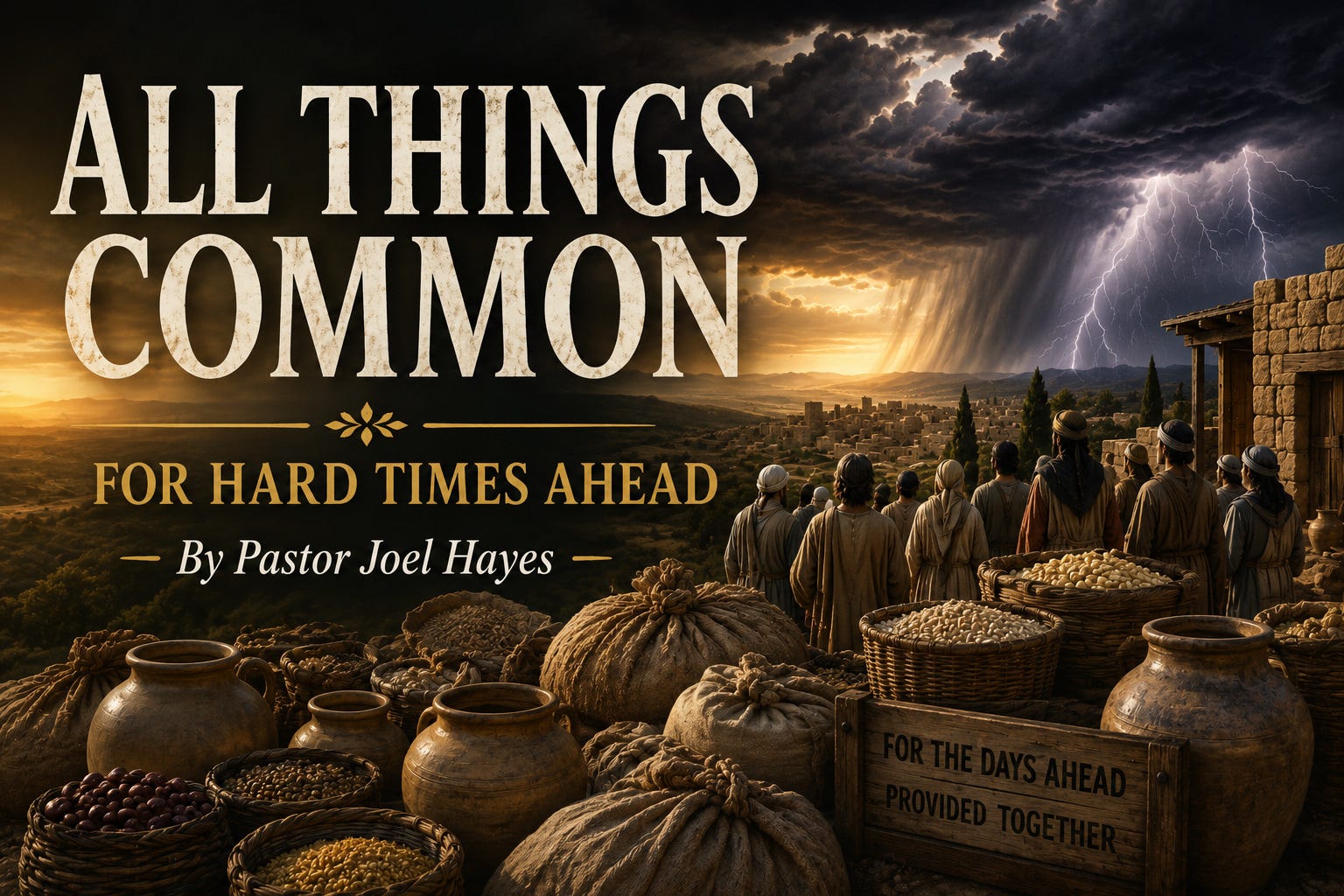
Why did the saints at Pentecost have “all things common?”
Was God endorsing communism?
Uhh, no. God forbid.
Let’s read some key passages:
Act 2:41 Then they that gladly received his word were baptized: and the same day there were added unto them about three thousand souls. Act 2:42 And they continued stedfastly in the apostles’ doctrine and fellowship, and in breaking of bread, and in prayers. Act 2:43 And fear came upon every soul: and many wonders and signs were done by the apostles. Act 2:44 And all that believed were together, and had all things common; Act 2:45 And sold their possessions and goods, and parted them to all men, as every man had need. Act 2:46 And they, continuing daily with one accord in the temple, and breaking bread from house to house, did eat their meat with gladness and singleness of heart, Act 2:47 Praising God, and having favour with all the people. And the Lord added to the church daily such as should be saved.
A Panoramic Snapshot
So after Peter’s first sermon (Acts 2:14-40), Luke steps back and gives us a broader picture. It’s like he’s zooming out to paint this panoramic snapshot of what’s happening with the converts, the established believers, and the 12 apostles.
Notice a few things here.
One of Peter’s key points was, “This is that which was spoken by the prophet Joel” (Acts 2:16-21). One cannot overstate how important those words were. Peter wasn’t establishing a new church for a new church age. He was saying that the miracles they were all witnessing had already been prophesied by Joel chapter two in the context of the end times. The outpouring of the Spirit was exactly what Joel said would happen… in the last days.
Peter also quoted what Joel wrote about the wonders that will take place in the end times - in heaven above, blood, and fire, vapour of smoke, and how the sun shall be turned into darkness, and the moon into blood, before that great and notable day of the Lord come.
In other words, the pouring out of the Holy Spirit is in the context of the end times. This is the prelude to the time of Jacob’s Trouble, or what we call the 7-year tribulation period. It’s as if Peter’s saying, “What you are seeing is precisely what was prophesied by Joel. The pouring out of the Spirit at Pentecost is the very event Joel had foretold in his book centuries earlier. This means that we’re headed into the time of Jacob’s Trouble. Time is running out. Judgment is coming in the Tribulation, and oh-by-the-way, God is mad at you for murdering His Son, your Messiah.”
There was no offer of a kingdom being made to Israel. The message was, “The end times is here, evidenced by the pouring of the Spirit prophesied by Joel, and therefore, you better turn or burn, because judgment is coming.”
Naturally, the crowd was deeply convicted. They were pricked in their hearts and asked, “Men and brethren, what shall we do?”
Peter called them to repent — to change their minds about Jesus Christ — and to identify with Christ through water baptism as part of Israel’s prophetic kingdom program. Three thousand people gladly received his word and were baptized that very day. Although that was likely a small fraction of the hundreds of thousands of Jews in Jerusalem at the time, this was still an incredible response.
In vs 43, we’re told that they were also terrified. Luke said, “fear came upon every soul: and many wonders and signs were done by the apostles.”
Why were they afraid?
Because they believed Peter. The signs and wonders meant the end times was here. They didn’t have the book of Revelation at the time, but there were enough prophecies about the Tribulation in the OT that they knew this would be a devastating time of great judgment (Jer. 30:6–7; Mal. 4:1) They knew the Tribulation was going to be bad. And they felt fear.
All Things Common
And this brings us to Act 2:44 And all that believed were together, and had all things common.
Notice first that it was only the believers who had all things common, not all of Israel. This was not political socialism or communism getting implemented in the nation of Israel. This was a supernatural spiritual practice being performed by believers only (see also Acts 4:32-35).
Why did they have all things common?
They were pooling their resources to survive the Tribulation. Every believer would have access to basic necessities when the judgments start coming.
During His earthly ministry, the Lord was all about His followers giving up all their possessions. He said, in passages like Luke 12:32-33, “Fear not, little flock; for it is your Father’s good pleasure to give you the kingdom. Sell that ye have, and give alms; provide yourselves bags which wax not old, a treasure in the heavens that faileth not, where no thief approacheth, neither moth corrupteth.”
Why did He instruct His followers to give up all their stuff?
He explains why in vs. 37. “Blessed are those servants, whom the lord when he cometh shall find watching…” This was about being ready for His Second Coming.
In fact, the Lord spends the entire chapter warning them about being ready for the return of the Master, the coming of the thief in the night, and facing division. He commands the “Little Flock” here (the believing remnant) to liquidate specifically to prepare for this tribulation period.
Thus, all things common in Acts 2 & 4 is all about the people doing what the Lord commanded to prepare for the Tribulation and His Second Coming.
The thing about the Gospel of the Kingdom at the time is that if the kingdom is at hand, then inevitably Daniel’s 70th week, the time of Jacob’s trouble, was also at hand. You cannot have one without the other. John the Baptist from the beginning was telling the people, “he that cometh after me is mightier than I, whose shoes I am not worthy to bear: he shall baptize you with the Holy Ghost, and with fire: Whose fan is in his hand, and he will throughly purge his floor, and gather his wheat into the garner; but he will burn up the chaff with unquenchable fire” (Mat 3:11b-12). God had begun purging His floor and separating the wheat from the chaff with John’s baptism. John’s message was, essentially, “Get right with God now or die in judgment in the Tribulation, because He is already purging His floor.”
If the people of Israel didn’t accept Christ by faith and be water baptized (and later filled with the Spirit), they were going to die in judgment in the Tribulation.
It was always a turn or burn message throughout the Gospels.
Therefore, there was no point in holding on to any of their possessions anymore since it’s all going to be destroyed and burned up in the Tribulation.
You might remember how the Lord said in Matt 24:15–16, “When ye therefore shall see the abomination of desolation... Then let them which be in Judaea flee into the mountains:” If you owned a house, or a piece of land, you’re kinda tethered to the property. You will hesitate to abandon it. But by liquidating their assets then at Pentecost, the believing remnant would be free to go run into the mountains when it’s time. With the burden of all their possessions gone, they’ll be free to flee at a moment’s notice, especially when the Antichrist defiles the Temple.
Pentecost wasn’t about the apostles inventing some new economic / political system in Israel. This was about them leading the people to obey the instructions the Lord had already given and pooling their resources to survive the Tribulation.
Question: why sell their land if land was never supposed to be permanently sold under the law? Under the Mosaic Law, land was an inalienable inheritance of a tribe. If you fell into poverty and had to sell your land, it had to be returned to your family in the Year of Jubilee (Leviticus 25:23–28). But here at Pentecost with all these people permanently liquidating their land and their homes, the believers were showing that they thought the entire economy of the Earth was going to be wiped out because God’s judgments were coming in the Tribulation.
Holding onto a deed was pointless when the whole system is about to collapse, and the fallout is going to be a brand new kingdom on Earth.
Having all things common would also help those who would be betrayed by their families when the Tribulation came. Micah warned about this (Micah 7:6). The Lord also talked about this. He said in Luke 21:16, “And ye shall be betrayed both by parents, and brethren, and kinsfolks, and friends; and some of you shall they cause to be put to death.” So believers having all things common were protecting themselves and other saints who will be betrayed by their families. They had formed an interdependent, closed society where they could look out for each other’s well-being during a time of lawlessness.
All things common would also help them in the Tribulation when they are denied goods and services in the marketplaces. Even before the Mark of the Beast, there will be such hatred and persecution for believers that they won’t have any hope of buying or selling anything. The Mark of the Beast merely streamlines what would already be going on for years. By selling their properties early (Acts 2:45) and pooling liquid cash into a single, centralized fund managed by the Apostles, the community built for themselves a kind of insulated economic buffer for when they are denied access to the marketplace.
They brilliantly created this self-sustaining, underground supply chain to feed, clothe, and shelter the remnant when the global economy shuts them out.
There are also parallels here to the days when Israel was wandering in the wilderness. You might remember from the End of the Word Series how we kept making connections between the judgments during the tribulation and the judgments on Egypt in the Exodus. There are more connections.
When the Jews wandered in the wilderness, they had a similar communal system in place before reaching the promised land. Granted, they didn’t give up all their possessions. Everyone kept what little they owned – like their flocks and herds (Exodus 12:38), tents (Numbers 2), and all the plunder of Egypt (Exodus 12:35).
But they traveled light.
They had no major assets.
They owned no land, no buildings, which will be very similar to the believing remnant in the Tribulation. AND there was a Pentecost-style communal system regarding the manna from Heaven. It had to be distributed fairly according to the need. God wasn’t going to tolerate hoarding. If a greedy Israelite tried to gather extra manna to hoard or sell to his neighbor, it bred worms and stunk by morning (Exodus 16:20). In those days, there was this equal communal treatment of God’s supernatural provisions of food, which will happen again in the Tribulation. It’s up there in the mountains hiding in God’s divine protection when the believing remnant will be saying the Lord’s Prayer and asking God for their daily bread. And that food, probably manna, will be distributed equally according to the need.
Plus, there were legal mandates for the Jews in the wilderness about helping each other and helping the sick and the poor. There was the expectation that they’d have to give of themselves to help others survive and this is perfectly realized with the saints began having all things common at Pentecost.
Remember Joseph and the coat of many colors and the famine in Egypt? Joseph famously gathered and centralized Egypt’s grain during the years of plenty so that it could be rationed out during the famine (Gen. 41:34-57, 47:13-26). The Apostles would have been doing the same thing with everything that was all things common. This ensured that when believers are shut out of the market, especially when the Mark of the Beast system arrives, resources were already consolidated under trusted, Spirit-filled leadership to be rationed out to saints.
I’ve also heard it said many times in grace circles that all things common was a dress rehearsal for life in the Kingdom. I used to think that way also, and I said that quite often on the podcast.
I don’t think that way anymore.
There’s a big difference between all things common at Pentecost and life in the millennial kingdom. At Pentecost, they owned nothing. In the kingdom, they’ll own everything. The Lord said in Psa. 2:8, “I shall give thee the heathen for thine inheritance, and the uttermost parts of the earth for thy possession.” Uttermost parts of the Earth means that they will possess the entire Earth, from one end of the globe to the other.
Pentecost was characterized by voluntary poverty, voluntary liquidation of all their assets, but the Kingdom is characterized by global ownership of everything, along with immense personal wealth, as part of their inheritance from God. This is a major contrast. This is the difference between liquidation vs. inheritance. When you’re selling all your property, you’re giving up all your assets. With inheritance, you’re gaining new assets.
Summation of All Things Common
1. Only the believers had all things common, not all of Israel.
2. This was about them pooling their resources for the sake of surviving the Tribulation.
3. By permanently liquidating their land and their homes, the believers were showing that they thought the entire economy of the Earth was going to be wiped out because God’s judgments were coming in the Tribulation.
4. Believers were also helping to protect themselves and other saints who will be betrayed by their own families.
5. Plus, this communal all things common system would help them through the period when they are denied goods and services in the marketplaces.
6. There are parallels to the Jews wandering in the wilderness and Joseph preparing for the famine in Egypt.
7. This was not a dress rehearsal for life in the Kingdom. At Pentecost, they owned nothing. In the kingdom, they’ll own everything. What was, in fact, a dress rehearsal for life in the Kingdom was their singleness of heart (Acts 2:46-47; cf Ezek. 11:19-20).
What They Did Not Know
Of course, what Peter and the believing remnant did not know — and could not have known — was that God would soon interrupt that prophetic timetable and do something nobody saw coming. He would put off His judgment onto the world and extend grace to everyone on the planet through the new Gospel of Grace given to the Apostle Paul to tell the world. God would usher in a temporary Dispensation of Grace. God had many times before inserted gaps into prophesy. So God paused the prophetic program, inserted a gap – this dispensation of grace – and then He’ll return to the prophetic program.
[This article is from my notes for my message on All Things Common as part of my new series on the book of Acts.]