

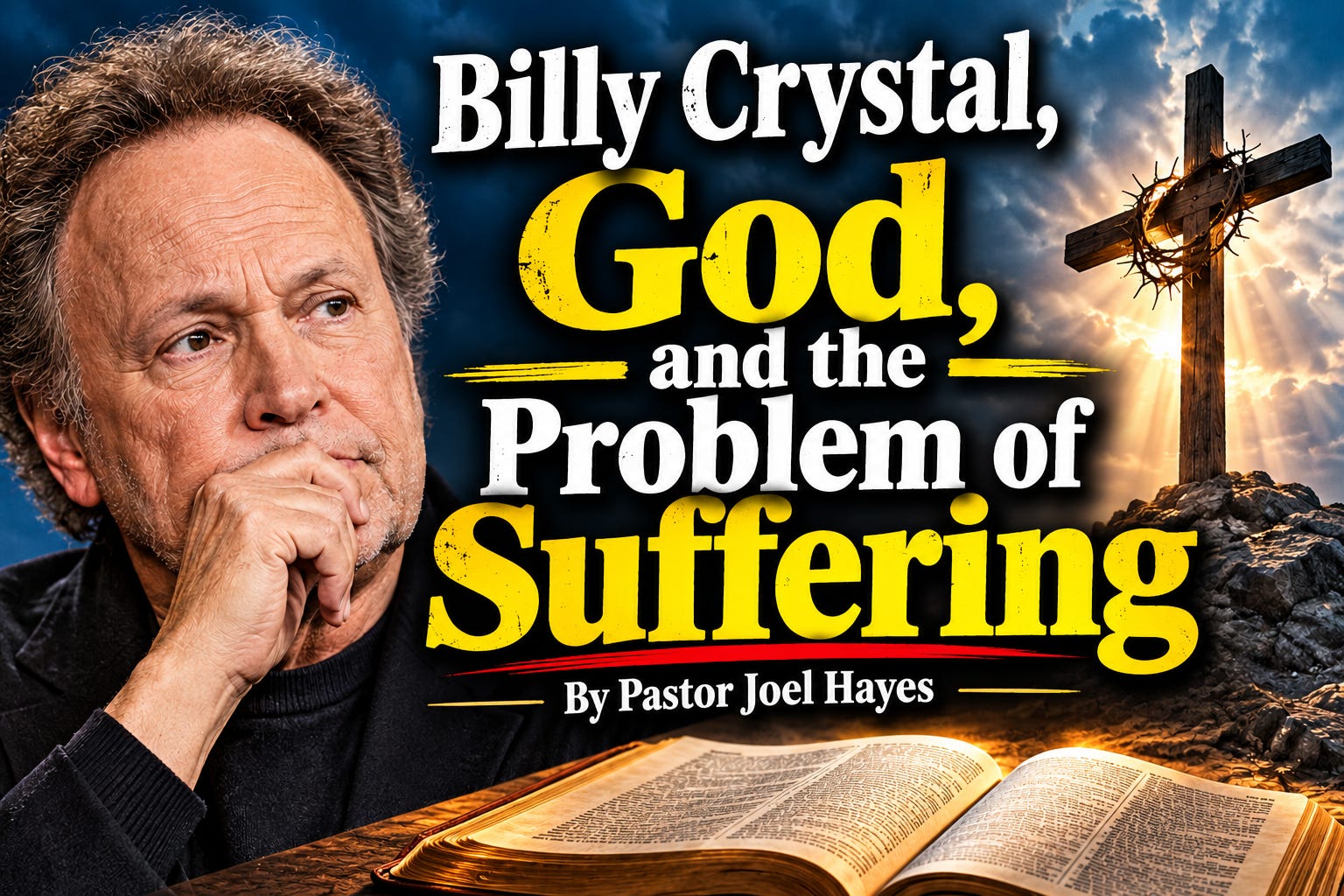
There have been several articles on Christian news sites (like this one) about actor and comedian Billy Crystal. He said in a recent interview with “CBS Sunday Morning” that devastating personal losses, like the loss of his home in the L.A. fire and the loss of his close friend Rob Reiner who was murdered has completely shaken his trust in God.
They asked him if he’s been talking to God during this difficult season of his life and Crystal replied, “No, because I don’t trust Him. Too many bad things have happened. The Earth is in bad shape. This is a weird, scary time. So no, not anymore.”
How heartbreaking.
I totally sympathize. I can’t imagine the pain of losing your home in a fire and then having to endure the murder of a close friend. My heart goes out to him. And I suspect there are millions of people who have experienced terrible losses and quietly asked the same questions he’s asking. Where is God in all this? Why does He allow these things to happen? And how can we possibly trust Him when this world seems so cruel?
Why do bad things happen?
“Wherefore, as by one man sin entered into the world, and death by sin; and so death passed upon all men, for that all have sinned” (Rom. 5:12). And “we know that the whole creation groaneth and travaileth in pain together…” (Rom. 8:22).
We live in a sin-cursed world. Sin entered into the world through Adam, and death entered through sin. Then Paul tells us that the whole creation groaneth and travaileth in pain together until now. The entire creation is subject to the bondage of corruption.
That’s the world we live in.
We live in a world of disease, suffering, natural disasters, accidents, deterioration, death, and sin-corrupted human beings making awful decisions. Being saved doesn’t exempt anyone from the issues of living in this sin-cursed world. God promises no one exemption from suffering in this life (Phil.1:29, 2 Tim. 3:12, 2 Cor. 4:8-9, 2 Cor. 12:7-10).
His Agony in the Garden
Of course, how can we forget the Lord’s agony in the Garden of Gethsemane before He died on the cross? When they arrived at the Garden, the first thing He tells the disciples, Sit ye here, while I go and pray yonder (Matt. 26:36). He goes further into the Garden to pray. He brings with Him Peter, James, and John. He tells them, “My soul is exceeding sorrowful unto death: tarry ye here, and watch.” When He gets His inner circle close to Him away from the other disciples, he tells them something no one could’ve known — and that was the crushing weight pressing on His soul about what’s going to happen to Him.
He says, “My soul is exceeding sorrowful…” This is not surface-level. This is the deepest part of His inner being — His entire inner life is overwhelmed with sorrow. In the Greek, “exceeding sorrowful” speaks of a grief that surrounds a person on every side. This is a sorrow that hems Him in with no escape. His entire being is engulfed in sorrow. It’s stunning really how He opens His heart to His inner circle here. This is not weakness. He is just sharing with them the enormous burden He is carrying inside.
And what has gripped Him is more than just fear of a physical death on a cross. A lot of martyrs have faced death with great composure — THIS is something altogether different. THIS is the full weight of God’s “cup” of wrath. This is the anticipation of everything that will happen to Him at Calvary, of being made a curse for sin, of suffering more than any being who ever existed, and perhaps the thing that weighed most on Him was that He’d be entering into this unimaginable period of divine forsaking by His Father (Psa. 22:1).
This is the sinless One standing on the edge of bearing the full weight of judgment for every bad thing the world has ever done. That is why He says, “…even unto death.” The anguish is so intense that it is pressing Him to the brink of death before He’s even arrested. Luke tells us His sweat became as it were great drops of blood — His intense suffering started long before the nails ever touched His hands.
On the Cross
When He was on the cross, I’d suggest that nobody ever suffered more than Christ Himself (Psa. 22, Isa. 53:11). He didn’t just suffer physically. He also suffered mentally, emotionally, and spiritually on the cross. In Psa. 22:2, the Lord says, “O my God, I cry in the daytime, but thou hearest not; and in the night season, and am not silent.” The Lord silently cried to His father in His mind throughout that entire ordeal and never got an answer.
In Psa. 22:12, we’d learn about the bulls of Bashan. David wrote, “Many bulls have compassed me: strong bulls of Bashan have beset me round.” The bulls of Bashan were these wild powerful uncontrollable beasts. Some have speculated, and I would agree, that in Psa. 22:12, the spiritual curtain has been pulled back, and in the spiritual realm these wild powerful uncontrollable demons, who like the bulls of Bashan, were all circling the cross. And what were they doing? They were tormenting Christ’s soul.
We also learn in Psa. 22:21 that the Lord was thinking, “Save me from the lion’s mouth...” We know who that is. 1 Pet. 5:8, “Be sober, be vigilant; because your adversary the devil, as a roaring lion, walketh about, seeking whom he may devour.” The devil was there in the spiritual realm at the cross tormenting His soul, along with all the demonic realm, and the Lord begged in His mind to His Father to be saved from the roaring lion’s mouth.
For all these reasons, I believe the Lord suffered more than any being who existed.
Just before He reached the ninth hour, we find in Mat 27:46 And about the ninth hour Jesus cried with a loud voice, saying, Eli, Eli, lama sabachthani? that is to say, My God, my God, why hast thou forsaken me? (Also in Mark 15:34) By saying these words, the Lord points us all back to Psalm 22 so that we may know that Psalm 22 reveals to us everything He’s thinking and feeling while He’s dying on the cross. He’s also showing us that His death was a fulfillment of that prophecy in Psalm, and we also know that He was forsaken of God the Father, fellowship broken for the first time since eternity past, because the Father cannot have fellowship with sin while the sins of the world were being imputed to His Son.
But the Father heard Him and watched everything (Psa. 22:24).
We’re told in Isa 53:6 …the LORD hath laid on him the iniquity of us all. And again in Isa 53:10-11 Yet it pleased the LORD to bruise him; he hath put him to grief: when thou shalt make his soul an offering for sin, he shall see his seed, he shall prolong his days, and the pleasure of the LORD shall prosper in his hand. He shall see of the travail of his soul, and shall be satisfied: by his knowledge shall my righteous servant justify many; for he shall bear their iniquities. And again in Isa. 53:8, for he was cut off out of the land of the living: for the transgression of my people was he stricken.
Why did Christ suffer more than any being who ever existed?
“For he hath made him to be sin for us, who knew no sin; that we might be made the righteousness of God in him” (2 Cor. 5:21). He died to save us. He became something He wasn’t so we can by grace through faith become something we’re not.
Christ died for our sins (1 Cor. 15:3). He was buried and He rose again the third day (1 Cor. 15:4). This is the gospel Paul preached wherein we all stand as believers.
Do you believe it?
How can we look at Christ’s suffering and conclude that God doesn’t care about us?
“For as the sufferings of Christ abound in us, so our consolation also aboundeth by Christ” (2 Cor. 1:5).