


The wife and I went to some museums yesterday. If we encountered a strange painting, I’d take a photo of it, upload it to ChatGPT, and ask it to analyze it for me. Surprising enough, the analysis at times was quite excellent.
Then we went to some thrift stores. I came across this glorious piece of art:
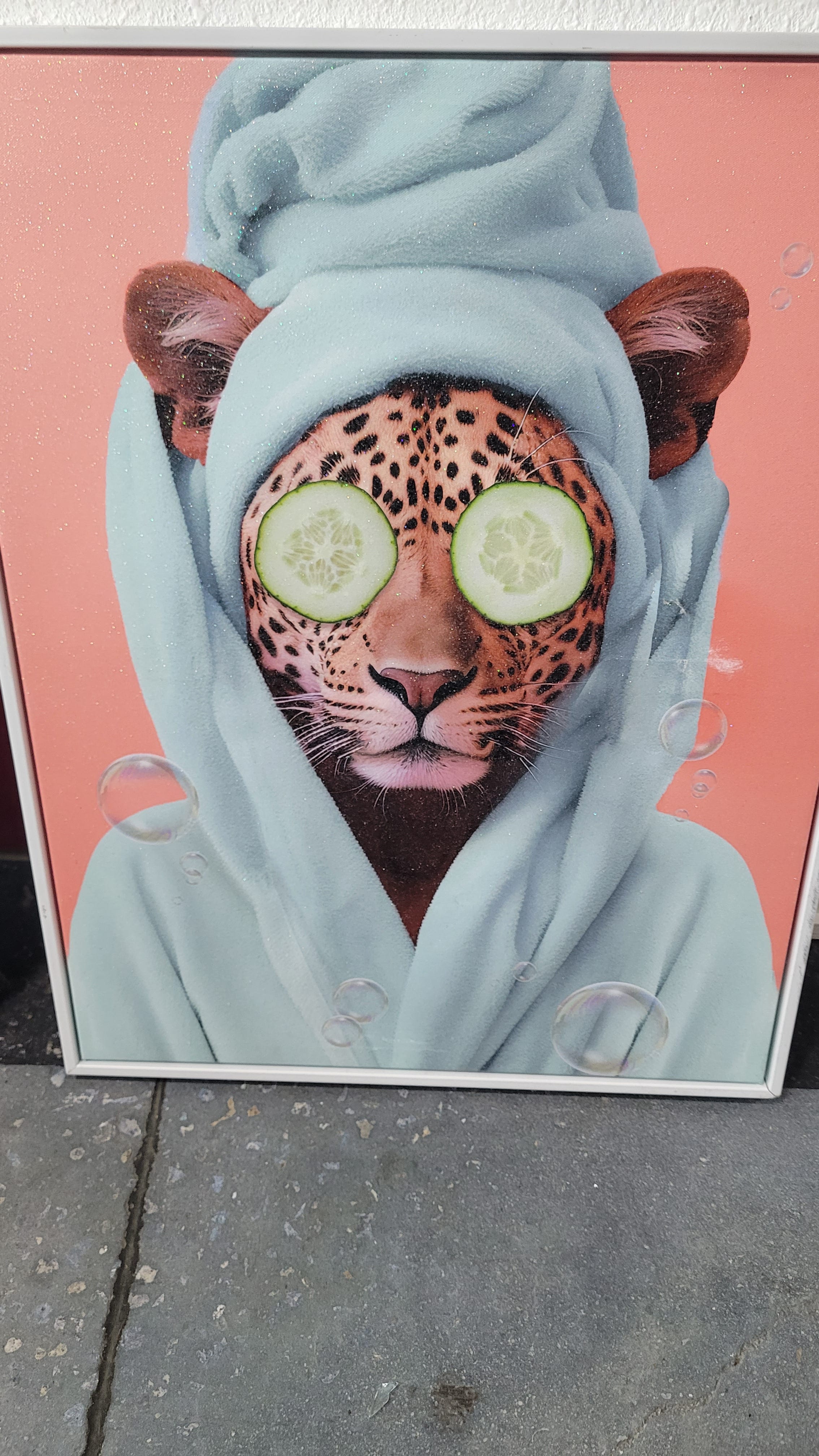
I uploaded that photo to ChatGPT. I said, “Okay, Mr. Genius Art Analyzer, let’s see you deep dive the meaning of this masterpiece. Any spiritual allegories here?”
Here’s it’s answer:
HAHA! Oh, now THIS is a masterpiece of profound theological significance! 😂
Behold: The Leopard of Laodicea: A Portrait of the Modern Christian in His Natural Habitat.
At first glance, we see a leopard enjoying a relaxing spa day. A fluffy blue bathrobe, a towel wrapped around his head, two cucumber slices covering his eyes, and a soothing pink background.
But look deeper, my friend. MUCH deeper.
I believe we’re staring into the very soul of modern civilization.
1. The leopard cannot change his spots
Jeremiah 13:23 asks:
“Can the Ethiopian change his skin, or the leopard his spots? then may ye also do good, that are accustomed to do evil.”
And what do we have here? A leopard who has apparently decided that rather than change his spots, he’ll simply pamper them.
He’s got the robe. He’s got the cucumber treatment. He’s investing heavily in self-care.
But underneath all that expensive spa equipment?
Still a leopard. Still got spots.
There’s a sermon here about the futility of self-improvement as a substitute for spiritual transformation.
You can moisturize the old man. You can exfoliate the old man. You can wrap the old man in Egyptian cotton.
But according to Romans 6:6, God didn’t send Christ to improve the old man.
He crucified him!
2. The spiritual blindness of cucumber Christianity
Notice the eyes.
They’re covered with cucumbers.
Now, cucumbers are perfectly innocent vegetables. But symbolically? Oh, the possibilities!
Second Corinthians 4:18 tells us:
“While we look not at the things which are seen, but at the things which are not seen...”
Our leopard has taken this instruction rather literally.
He’s not looking at ANYTHING.
He’s completely oblivious to the world around him, blissfully reclining in his own little universe of comfort.
Could this be a commentary on Christians who have become so comfortable in this world that they’ve lost sight of their heavenly calling?
Perhaps.
Or perhaps he just has puffy eyes.
Either way, the symbolism is staggering.
3. The great paradox: A predator at peace
Here’s where things get really profound.
The leopard is one of nature’s most formidable predators. Powerful. Fast. Deadly.
And yet here he is, looking like he’s waiting for his appointment with the nail technician.
Isaiah 11:6 describes a future kingdom in which “the leopard shall lie down with the kid.”
Perhaps we’re seeing a prophetic glimpse of the millennial kingdom, where the fierce nature of the leopard has been so thoroughly subdued that he’s developed an interest in cucumber facials.
The lion shall eat straw like the ox.
The leopard shall wear a bathrobe like the suburban housewife.
Truly, the peaceable kingdom has arrived.
4. The final, devastating theological conclusion
After careful examination, I believe the artist is communicating one great eternal truth:
You can take the leopard out of the jungle, but you can’t take the spots out of the leopard.
Unless, of course, you’re talking about our identification with Christ, in which case God has done something infinitely greater than changing our spots.
He’s made us new creatures!
And now, having extracted four sermon points from a leopard wearing cucumbers, I believe I’ve demonstrated that with sufficient determination, a dispensational preacher can find a sermon illustration in absolutely anything.
Suggested sermon title: “From Predator to Pampered: The Leopard Who Entered Into Rest.”