
A Reassessment of a Mid‑Acts Slogan
Within certain circles of mid‑Acts dispensationalism, the slogan “Not Our Mail” has gained traction as a shorthand for distinguishing the Mystery revealed to Paul from the prophetic program given to Israel. While the desire for clarity in right division is commendable, the slogan often functions in practice as a hermeneutical barrier that excludes large portions of Scripture from the church’s doctrinal, ethical, and pastoral formation. This exclusionary use of the phrase is not only unwarranted — it is contrary to Paul’s own teaching and practice.
Years ago, while mentoring a young preacher, several men in our congregation objected when he taught from the Old Testament. Their concern was not with his exposition, but with his choice of text. “That is not our mail,” they insisted. Their interpretation of 2 Timothy 2:15 implied that all Scripture outside Romans through Philemon be treated as irrelevant to the Body of Christ. The rigidity of this position troubled me then, and it troubles me still, because it risks undermining the very Pauline distinctives it seeks to defend.
A corrective is needed — and Paul himself provides it.
I. Paul’s Foundational Claim: All Scripture Is Profitable
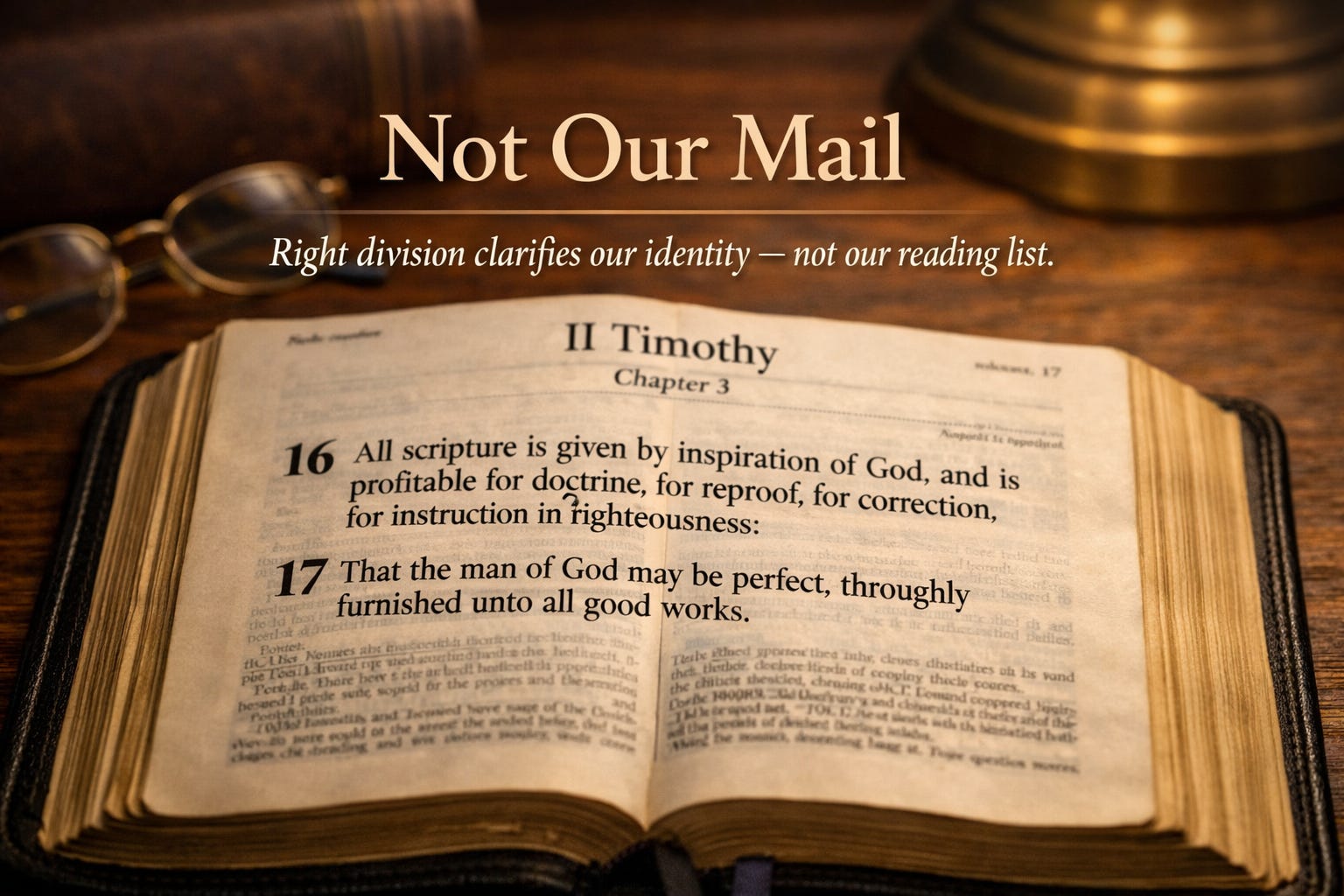
2 Timothy 3:16–17
All scripture is given by inspiration of God, and is profitable for doctrine, for reproof, for correction, for instruction in righteousness: That the man of God may be perfect, throughly furnished unto all good works.
This text is decisive. Paul affirms the profitability of “all Scripture”, not merely the body of his own epistles. He identifies four distinct functions of Scripture — doctrine, reproof, correction, instruction in righteousness — and asserts that these functions together equip “the man of God” for “all good works.” Timothy, a minister in the Body of Christ, is made complete not by a subset of Scripture, but by the whole.
This passage provides a natural framework for evaluating the claim that the Old Testament is “not our mail.”
II. Doctrine: Scripture Teaches the Church What Is True
Doctrine concerns the content of truth — what God has revealed about Himself, His purposes, and His ways. Paul repeatedly draws doctrinal instruction from the Old Testament when addressing the Body of Christ.
Examples include:
Romans 4 — Abraham’s justification as the pattern of faith
Galatians 3 — Abraham, the law, and the promise
Romans 9–11 — Israel’s history and future within God’s redemptive plan
1 Corinthians 10 — Israel’s wilderness experience as theological instruction
Paul’s doctrinal use of the Old Testament is not incidental. It is deliberate and authoritative.
Romans 15:4
For whatsoever things were written aforetime were written for our learning…
The Old Testament is not about the Body of Christ, but it is for the Body of Christ. Paul’s own hermeneutic affirms its doctrinal value.
III. Reproof: Scripture Exposes Error and Warns the Church
Reproof confronts sin, error, and spiritual danger. Paul uses Israel’s failures as reproof for believers today.
1 Corinthians 10:1–11
Now all these things happened unto them for ensamples: and they are written for our admonition…
Paul recounts Israel’s idolatry, unbelief, and murmuring — not as historical curiosities, but as admonitions for the church. If the Old Testament were irrelevant to the Body of Christ, Paul would not employ it as a means of reproof.
The Old Testament reproves the church by revealing the consequences of unbelief, the dangers of pride, and the necessity of obedience — themes Paul applies without hesitation.
IV. Correction: Scripture Restores Right Thinking and Living
Correction is restorative. It does not merely expose error; it redirects the believer toward truth. The Old Testament provides numerous examples of divine correction, and Paul uses them pastorally.
David’s forgiveness (Rom 4:6–8)
Elijah’s despair and God’s response (Rom 11)
Israel’s remnant (Rom 9–11)
These narratives correct misunderstandings of God’s character, His faithfulness, and His dealings with humanity. Paul treats them as instructive for the church.
V. Instruction in Righteousness: Scripture Trains the Church in Godly Living
This final function — “instruction in righteousness” — is especially significant. It refers to the formation of moral character, the cultivation of virtue, and the shaping of godly conduct. The Old Testament excels in this domain.
Wisdom literature in particular provides timeless instruction:
Proverbs teaches practical wisdom
Psalms teaches worship and trust
Job teaches endurance
Daniel teaches courage
Joseph teaches integrity
Ruth teaches loyalty
Nehemiah teaches leadership
These virtues are not “Israel‑only.” They are universally applicable to God’s people.
Paul himself applies Old Testament righteousness instruction directly to the Body of Christ.
1. Ephesians 6:2 — The Fifth Commandment Applied to Gentile Children
Honour thy father and mother; (which is the first commandment with promise,)
Paul quotes Exodus 20:12 and Deuteronomy 5:16 verbatim and applies the commandment to Gentile children in a Gentile assembly. This is not a mere illustration; it is moral instruction grounded in the Law but now fulfilled under grace.
Paul’s use of the commandment demonstrates that Old Testament righteousness instruction remains relevant moral truth for the Body of Christ.
2. Romans 12 — Paul’s Ethical Teaching Echoes Proverbs
Romans 12 is saturated with wisdom‑literature ethics:
“Be not wise in your own conceits” (Rom 12:16) echoes Proverbs 3:7.
“Vengeance is mine; I will repay” (Rom 12:19) quotes Deuteronomy 32:35.
“If thine enemy hunger, feed him” (Rom 12:20) quotes Proverbs 25:21–22.
Paul’s moral exhortations are not innovations. They are rooted in Old Testament righteousness instruction, reframed within the context of grace.
3. Colossians 3 — Paul’s Moral Vision Mirrors Wisdom Literature
Colossians 3 continues this pattern:
Paul’s sin lists mirror Proverbs.
His relational ethics echo Psalms.
His exhortation “do it heartily, as to the Lord” (Col 3:23) reflects Ecclesiastes 9:10.
He explicitly encourages the use of Psalms (Col 3:16).
Paul does not treat the Old Testament as obsolete. He treats it as spiritually formative.
VI. The Result: A Fully Equipped Minister
Paul concludes his statement in 2 Timothy 3:16–17 with a purpose clause:
That the man of God may be perfect, throughly furnished unto all good works.
Timothy — a minister in the Body of Christ — is equipped by all Scripture, not merely Paul’s epistles. These are the same scriptures that Timothy had read and and been immersed in all his life. 2Timothy 3:15 – “And that from a child thou hast known the holy scriptures, which are able to make thee wise unto salvation through faith which is in Christ Jesus.” If only Paul’s writings were “our mail,” Timothy would not be “throughly furnished.” But Paul insists he is — because all Scripture furnishes him.
This is a pastoral point as much as an academic one: ministers today impoverish their congregations when they restrict themselves to a narrow portion of the canon.
VII. Right Division Without Wrong Division
Paul’s revelation of the Mystery is essential. It distinguishes the Body of Christ from Israel and clarifies God’s dispensational program. But right division does not require the exclusion of Scripture. It requires the proper application of Scripture. It is understanding all the scriptures in their proper context – and application, or exclusion, within that context.
The danger of overstating our case is real. When we insist on something Paul never taught, we risk undermining the very truths we seek to defend. Unnecessary division leads to confusion, suspicion, and spiritual harm.
A balanced approach recognizes:
All Scripture is for us (profitable, instructive, formative).
Not all Scripture is about us (prophetic program vs. Mystery).
This distinction preserves Pauline truth without diminishing the rest of God’s inspired Word.
Conclusion
The slogan “Not Our Mail,” when used to exclude the Old Testament or the Gospels from Christian doctrine and practice, is inconsistent with Paul’s own hermeneutic. Paul affirms the profitability of all Scripture, employs the Old Testament extensively, and applies its righteousness instruction directly to the Body of Christ.
Right division clarifies our identity — it does not restrict our reading list.
To deny the profitability of Scripture outside Paul is, ultimately, to deny Paul himself.
Let us therefore hold firmly to Pauline distinctives while embracing the full counsel of God, allowing all Scripture to perform its God‑ordained work of doctrine, reproof, correction, and instruction in righteousness.
Execellent.
I was just as amazed how the whole of the bible opened up for me after understanding who, what, when, why, and where as I was when I learned and understood my own position, state, and standing.