

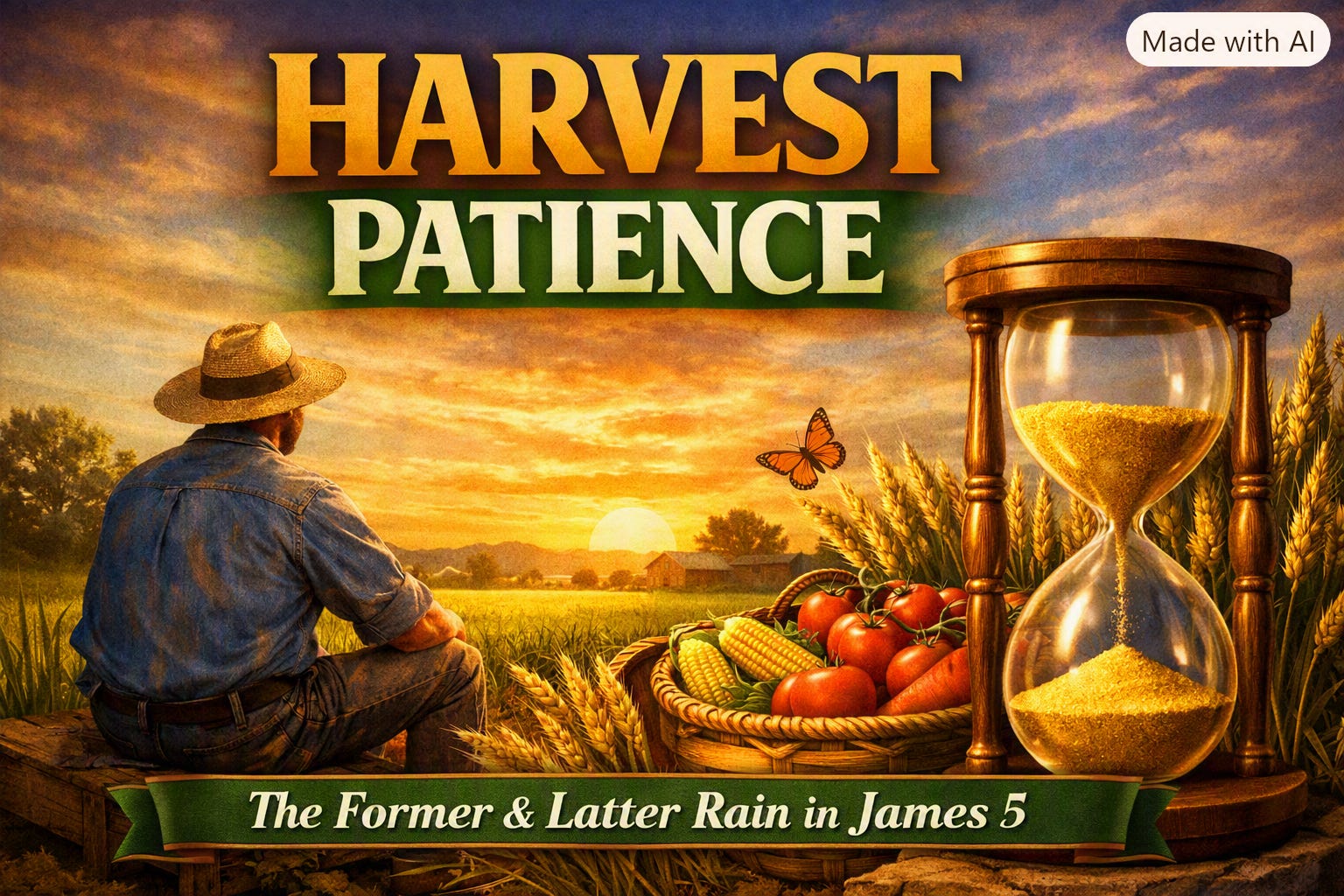
“Be patient therefore, brethren, unto the coming of the Lord. Behold, the husbandman waiteth for the precious fruit of the earth, and hath long patience for it, until he receive the early and latter rain. Be ye also patient; stablish your hearts: for the coming of the Lord draweth nigh” (James 5:7–8).
The expression “the latter rain” is sometimes used to describe a special or renewed outpouring of the Holy Spirit. In some systems of interpretation, the former rain is associated with Pentecost and the latter rain with a second, greater spiritual outpouring near the end of the age.
That interpretation, however, should not be assumed and then imposed upon James’s words. We must first ask what James himself is saying. What does the husbandman await? How would the twelve tribes, to whom James writes, understand the early and latter rain? What part does the imagery play in James’s exhortation?
When the passage is read in its immediate context and against its Old Testament background, its emphasis becomes clear. James does not identify the rain as the Holy Spirit. He draws upon Israel’s familiar agricultural, covenantal, and prophetic vocabulary of rain, fruit, waiting, and harvest. His purpose is to teach suffering believers to endure patiently as they await the coming of the Lord and the certainty of God’s promised blessing.
1. Let James Set the Terms
James introduces his epistle as “a servant of God and of the Lord Jesus Christ” and addresses it “to the twelve tribes which are scattered abroad” (James 1:1). This identification is important. James is writing to people whose Scriptures were filled with promises and warnings concerning rain, harvest, fruitfulness, judgment, and restoration.
The closing chapter retains this distinctly prophetic atmosphere. James announces judgment upon oppressive rich men whose wealth has been corrupted and whose conduct has brought suffering upon the righteous. He then turns to the afflicted brethren and tells them to wait patiently “unto the coming of the Lord” (James 5:7).
The surrounding expressions are equally significant:
“The coming of the Lord draweth nigh” (verse 8).
“The judge standeth before the door” (verse 9).
The prophets are presented as examples of suffering and patience (verse 10).
Job is remembered for his endurance and the Lord’s final purpose toward him (verse 11).
Elijah is recalled in connection with withheld and restored rain (verses 17–18).
James therefore places the early and latter rain within a context of suffering, judgment, prophetic expectation, patient endurance, and the coming of the Lord. Before the rain is made to represent a particular spiritual experience, it should be understood according to the setting James has supplied.
The controlling subject of the passage is not a special reception of spiritual power. It is the necessity of patient endurance while awaiting the Lord’s coming.
2. The Husbandman Awaits a Harvest
James’s illustration is straightforward: “Behold, the husbandman waiteth for the precious fruit of the earth.”
The husbandman is a farmer. He has labored in expectation of a harvest, but he cannot command the seasons or produce the crop instantly. He must exercise “long patience” until the earth has received the necessary rain and brought forth its fruit.
The farmer’s attention is fixed upon “the precious fruit of the earth.” The early and latter rain belong to the process by which that fruit is produced. The early rain prepares the soil and supports the beginning of the growing season; the latter rain helps bring the crop to maturity before harvest. The farmer waits through the entire appointed season because he is confident that the harvest will come.
James then applies the illustration directly:
“Be ye also patient; stablish your hearts.”
As the husbandman waits for the harvest, James’s readers are to wait for the coming of the Lord. The farmer’s patience does not mean inactivity or uncertainty. It is settled endurance based upon confidence in an appointed outcome.
The husbandman cannot manufacture the rain, hasten the season, or produce the harvest through impatience. He waits because the order established by God gives him reason to expect fruit. In the same way, the suffering believers addressed by James are called to remain steadfast because God’s promised purpose is certain.
The point of the illustration is therefore not that the husbandman receives the rain as a spiritual experience. The rain falls upon the earth so that the earth may yield its fruit. The husbandman waits for the completion of that process. Likewise, James’s readers must endure until the Lord comes and God’s purpose is brought to its appointed fulfillment.
3. Rain in Israel’s Covenant Vocabulary
The language of the early and latter rain did not originate with James. It belonged to Israel’s covenant vocabulary.
Moses told Israel:
“And it shall come to pass, if ye shall hearken diligently unto my commandments which I command you this day, to love the LORD your God, and to serve him with all your heart and with all your soul, that I will give you the rain of your land in his due season, the first rain and the latter rain, that thou mayest gather in thy corn, and thy wine, and thine oil” (Deuteronomy 11:13–14).
The rain promised here is literal rain upon Israel’s land. It produces corn, wine, oil, and the other fruits necessary for the nation’s well-being. Under the covenant, however, physical rain also carried governmental significance. Its presence testified to divine blessing, while its absence could testify to covenant chastening.
Israel was warned that if the nation turned aside to serve other gods, the Lord would “shut up the heaven, that there be no rain” (Deuteronomy 11:17). Among the curses associated with disobedience, Moses declared that the heaven over Israel’s head would become brass and that the rain of the land would be turned into powder and dust (Deuteronomy 28:23–24).
This pattern continues throughout Israel’s history.
Jeremiah explained that Israel’s sins had caused the showers to be withheld. He also told the people, “Your iniquities have turned away these things, and your sins have withholden good things from you” (Jeremiah 5:25). Solomon’s prayer at the dedication of the temple likewise anticipated a time when heaven might be shut because Israel had sinned. Confession, prayer, and turning from sin were connected with forgiveness and the restoration of rain (2 Chronicles 6:26–27).
Rain was therefore both a physical necessity and a covenant sign. It belonged to God’s administration of Israel’s life in the land. The early and latter rain meant that God was providing the seasonal blessing necessary for fruitfulness and harvest.
When James uses this vocabulary while writing to the twelve tribes, he is not borrowing an unrelated expression and giving it an entirely new meaning. He is speaking in terms deeply rooted in Israel’s Scriptures.
4. Rain in Israel’s Prophetic Hope
The prophets carried the imagery of rain beyond Israel’s immediate agricultural life and placed it within the nation’s hope of repentance, restoration, and the coming of the Lord.
Hosea called Israel to return to the Lord:
“Come, and let us return unto the LORD: for he hath torn, and he will heal us; he hath smitten, and he will bind us up” (Hosea 6:1).
The prophet then declared:
“Then shall we know, if we follow on to know the LORD: his going forth is prepared as the morning; and he shall come unto us as the rain, as the latter and former rain unto the earth” (verse 3).
The similarity to James is striking. Hosea joins the coming of the Lord with the familiar image of rain upon the earth. James tells his readers to wait patiently for the early and latter rain and immediately adds, “for the coming of the Lord draweth nigh.”
Joel also describes the restoration of Israel in agricultural terms:
“Be glad then, ye children of Zion, and rejoice in the LORD your God: for he hath given you the former rain moderately, and he will cause to come down for you the rain, the former rain, and the latter rain” (Joel 2:23).
The following verses speak of floors full of wheat, vats overflowing with wine and oil, and the restoration of the years consumed by destructive armies. The people will eat in plenty and praise the Lord, and Israel will no longer be put to shame.
Psalm 72 uses similar imagery in describing the righteous reign of the King: “He shall come down like rain upon the mown grass: as showers that water the earth” (verse 6). Zechariah also connects future blessing with the Lord’s provision of rain.
This prophetic background enriches James’s illustration. The farmer’s rain is literal, but the imagery carries the weight of Israel’s expectation. Rain, fruitfulness, restoration, righteous government, and the coming of the Lord repeatedly appear together in Israel’s prophetic hope.
James can therefore employ a simple agricultural picture while drawing upon a much larger scriptural pattern. His readers are suffering, but their suffering will not have the final word. The Judge stands before the door. The Lord will come, and God’s promised purpose will not fail.
5. Joel Distinguishes the Rain from the Spirit
The close association between the latter rain and Joel’s prophecy has sometimes led interpreters to identify the rain itself with the outpouring of the Holy Spirit. Joel, however, distinguishes the two.
Joel 2:23–27 describes physical and agricultural restoration:
The former and latter rain come upon the land.
The floors become full of wheat.
The vats overflow with wine and oil.
The years of loss are restored.
Israel eats in plenty and is satisfied.
Only after describing these blessings does Joel introduce the promise of the Spirit:
“And it shall come to pass afterward, that I will pour out my spirit upon all flesh” (Joel 2:28).
The word “afterward” marks a progression in the prophecy. The rain and the outpouring of the Spirit belong to the same broad prophetic program of Israel’s restoration, but Joel does not identify them as the same event or substance. The rain is rain; the Spirit is the Spirit.
When Peter speaks on the day of Pentecost, he does not say, “This is the latter rain.” He says, “This is that which was spoken by the prophet Joel,” and then quotes the portion of Joel concerning the outpouring of the Spirit (Acts 2:16–18).
Scripture thus gives no basis for turning “the latter rain” into a technical designation for a second Pentecost or a modern spiritual outpouring. Such an interpretation depends upon joining images that the prophetic text itself distinguishes.
This does not diminish the work of the Holy Spirit. It simply permits each biblical promise to retain the meaning given to it in its own context. Believers today are united in one Body by the Spirit: “For by one Spirit are we all baptized into one body” (1 Corinthians 12:13). This spiritual identification should not be confused with the covenant rain promised to Israel or with the agricultural image James uses to teach patience.
6. Elijah Confirms James’s Meaning
James provides his own internal confirmation near the end of the chapter.
“Elijah was a man subject to like passions as we are,” James writes, “and he prayed earnestly that it might not rain: and it rained not on the earth by the space of three years and six months” (James 5:17).
James then adds:
“And he prayed again, and the heaven gave rain, and the earth brought forth her fruit” (verse 18).
The parallel with verse 7 is difficult to miss:
In verse 7, the husbandman waits for rain so that the earth may bring forth precious fruit.
In verse 18, heaven gives rain and the earth brings forth fruit.
James begins his exhortation with rain, earth, and fruit, and he closes the chapter by returning to rain, earth, and fruit. Elijah’s experience supplies a scriptural example drawn directly from Israel’s covenant history.
The drought in Elijah’s day was not a charismatic phenomenon. It was divine judgment upon an apostate nation. Ahab and Jezebel had promoted Baal worship, and Israel had forsaken the Lord’s covenant. The withholding of rain corresponded exactly to the warnings given through Moses. Its restoration demonstrated both the Lord’s sovereignty and His dealings with Israel under the covenant.
Elijah’s appearance in James 5 therefore reinforces the natural sense of the earlier illustration. James has literal rain in view—rain connected with the earth, fruitfulness, Israel’s covenant history, and the government of God.
Elijah also contributes to James’s practical purpose. The prophet endured during a time of national apostasy. He depended upon God through years of drought, and he prayed in confidence that God’s declared purpose would be accomplished. James’s readers are likewise called to remain faithful under difficult conditions.
7. “Stablish Your Hearts”
After examining the covenantal and prophetic background, we must return to James’s principal exhortation:
“Be ye also patient; stablish your hearts: for the coming of the Lord draweth nigh.”
The principal subject of James 5:7–8 is not rain. It is patient endurance in expectation of the Lord’s coming. The rain serves the illustration; the coming of the Lord supplies the believer’s hope.
James reinforces this exhortation through a succession of witnesses.
The husbandman waits because the harvest is precious and the appointed rains will accomplish their work. The prophets endured suffering while speaking in the name of the Lord. Job endured terrible affliction and eventually saw “the end of the Lord,” proving that the Lord is “very pitiful, and of tender mercy” (James 5:11). Elijah lived and prayed through a period of drought until the rain returned and the earth yielded fruit.
Together these examples declare that present suffering does not mean God has abandoned His purpose. Delay does not mean uncertainty. The apparent triumph of injustice does not mean that judgment will never come. The Lord remains faithful, the Judge stands before the door, and the promised harvest is certain.
To “stablish” the heart is to make it firm and settled. James’s readers must not be governed by the instability of their circumstances. Their hearts are to rest upon the certainty of the Lord’s coming.
The husbandman cannot pull fruit from the earth before its season. Neither can he improve the harvest through anxiety. He labors, watches, and waits because he trusts the order God has established. In the same way, believing Israel is called to endure suffering with confidence that God will fulfill His covenant and prophetic purpose.
The progression of James’s argument is therefore plain:
The husbandman waits.
The prophets endured.
Job endured.
Elijah prayed, and the rain returned.
The earth brought forth its fruit.
The coming of the Lord draws near.
The former and latter rain should not be transformed into a prediction of recurring Pentecostal outpourings. The expression belongs to the covenantal, agricultural, and prophetic vocabulary of Israel. James employs that familiar pattern to assure suffering believers that God’s appointed purpose is moving toward fulfillment.
The rain will come in its season. The earth will yield its fruit. The Lord will fulfill His word.
“Be ye also patient; stablish your hearts.”