

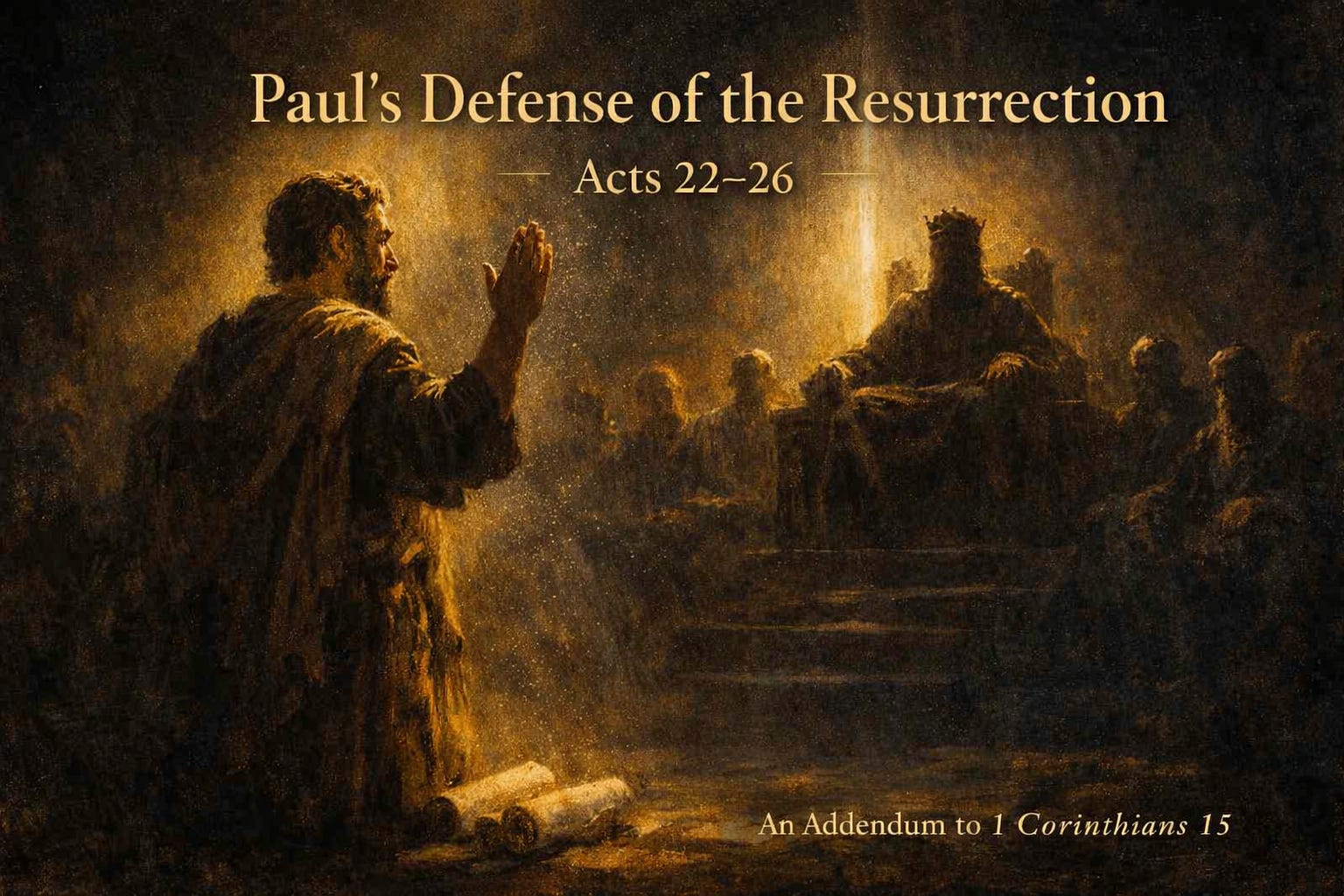
Introduction: The Real Issue in Paul’s Trials
Across Acts 22–26, Paul is not merely defending himself against accusations. He is bearing witness to the risen Christ. Each appearance—before the Jewish crowd, the Sanhedrin, Felix, Festus, and Agrippa—reveals that the controversy surrounding Paul is ultimately theological: the resurrection of Jesus Christ and the promised resurrection of the dead.
Central thesis: Paul’s defense is not rooted in personal vindication but in the claim that God has raised Jesus from the dead, thereby fulfilling both Israel’s hope and confirming the gospel of Christ he preached.
Five Hearings, One Resurrection Hope
Luke presents Paul’s defenses in a deliberate sequence. The audiences change, the legal setting intensifies, and the political stakes rise; yet the message remains consistent. Paul’s life was transformed by the risen Jesus, and his preaching rests on the conviction that God raises the dead.
1. Acts 22 — Paul speaks to the Jewish crowd in Jerusalem.
2. Acts 23 — Paul testifies before the Sanhedrin.
3. Acts 24 — Paul answers accusations before Felix.
4. Acts 25 — Festus summarizes the dispute.
5. Acts 26 — Paul gives his fullest defense before Agrippa.
The repeated theme is unmistakable: Paul is on trial because he proclaims that Jesus is alive and that resurrection is the hope promised by God.
Acts 22: The Risen Christ Confronts Paul
Paul’s account; Acts 22:6–10 KJV: “And it came to pass, that, as I made my journey, and was come nigh unto Damascus about noon, suddenly there shone from heaven a great light round about me. And I fell unto the ground, and heard a voice saying unto me, Saul, Saul, why persecutest thou me? And I answered, Who art thou, Lord? And he said unto me, I am Jesus of Nazareth, whom thou persecutest.”
Before the Jerusalem crowd, Paul begins with his former zeal and persecution of the church. This gives weight to his testimony: he was not predisposed to follow Christ. His conversion came because Jesus Himself appeared to him alive.
The resurrection is implied through the encounter. Paul does not argue abstract doctrine first; he recounts a personal confrontation with the living Lord. The Jesus whom Paul opposed was not dead and defeated but alive and speaking.
Paul’s apostleship rests on resurrection authority. The risen Christ called him, corrected him, and commissioned him.
Acts 23: The Resurrection Divides the Council
Visible Scripture — Acts 23:6 KJV: “Men and brethren, I am a Pharisee, the son of a Pharisee: of the hope and resurrection of the dead I am called in question.”
Before the Sanhedrin, Paul identifies the theological center of the dispute. His statement exposes the division between Pharisees, who affirmed resurrection, and Sadducees, who denied it.
Paul’s defense is not a diversion from the gospel. It is the gospel’s contested foundation. If God raises the dead, then the resurrection of Jesus is credible, decisive, and demanding.
Acts 24: Resurrection as the Hope of the Just and Unjust
Again, Paul declares — Acts 24:14–15 KJV: “But this I confess unto thee, that after the way which they call heresy, so worship I the God of my fathers, believing all things which are written in the law and in the prophets: And have hope toward God, which they themselves also allow, that there shall be a resurrection of the dead, both of the just and unjust.”
Before Felix, Paul insists that his message is not a rejection of Israel’s Scriptures. Rather, he stands within the hope promised in the Law and the Prophets. Resurrection is not an innovation detached from Scripture; it is the promised future toward which Scripture points.
Paul also widens the doctrine: resurrection concerns both the righteous and the wicked. The issue is not only comfort for believers but accountability before God.
Acts 25: Festus Names the Controversy
Festus clear decaration— Acts 25:19 KJV: “But had certain questions against him of their own superstition, and of one Jesus, which was dead, whom Paul affirmed to be alive.”
Festus, though not fully grasping the theological weight of the matter, accurately identifies the central claim: Jesus had died, but Paul affirmed Him to be alive.
This summary is significant because it comes from an outsider. Even a Roman official can see that Paul’s case turns on the resurrection of Jesus Christ.
Acts 26: Resurrection and the Promise to Israel
Paul stands before King Agrippa — Acts 26:6–8 KJV: “And now I stand and am judged for the hope of the promise made of God unto our fathers: Unto which promise our twelve tribes, instantly serving God day and night, hope to come. For which hope’s sake, king Agrippa, I am accused of the Jews. Why should it be thought a thing incredible with you, that God should raise the dead?”
Before Agrippa, Paul gives his most developed defense. He connects resurrection directly to the promise made to Israel. The gospel is not a contradiction of that promise; it is its fulfillment in the risen Christ.
Paul’s question presses the issue: if God is truly God, resurrection is not incredible. The problem is not divine inability but human unbelief.
Comparison: Paul’s Resurrection Emphasis in Acts 22–26
The following chart shows how each defense advances the same central claim from a different angle.
Passage - Audience / Setting - Visible Resurrection Emphasis - Significance
Acts 22 - Jewish crowd in Jerusalem
Jesus appears to Paul alive and commissions him.
Paul’s testimony begins with direct encounter with the risen Christ.
Acts 23:6 - Sanhedrin
“Hope of the resurrection of the dead.”
The resurrection exposes the true theological conflict.
Acts 24:14–15 - Felix
Resurrection of both the righteous and the wicked.
Paul roots resurrection in the Law, the Prophets, and coming judgment.
Acts 25:19 - Festus
Paul claims that Jesus, though dead, is alive.
An outsider identifies the resurrection of Jesus as the heart of the case.
Acts 26:6–8 - Agrippa
God’s promise to Israel includes raising the dead.
Paul presents resurrection as reasonable, biblical, and fulfilled in Christ.
Paul’s defense shows that the resurrection is not a secondary doctrine. It is the center of apostolic preaching, the validation of Jesus Christ’s identity, and the guarantee that God’s promises have not failed.
In Acts 22–26, resurrection connects Paul’s personal conversion, public witness, biblical/prophetical continuity, final judgment, and apostolic calling. Paul’s message cannot be separated from the living Christ who appeared to him and sent himas an apostle of Jesus Christ.
Therefore, the hope of Israel and the gospel of Christ to the nations meet in one truth: God has raised Jesus, and through Him the resurrection hope is proclaimed to all.
Conclusion
Paul’s courage before hostile crowds, religious councils, and Roman officials teaches believers to anchor their witness in the resurrection. The gospel does not rest on moral improvement, religious tradition, or personal sincerity alone; it rests on the historical and theological claim that Christ is risen.
Because Christ lives, the believer’s hope is secure, judgment is certain, and gospel witness is urgent. Paul’s defense becomes the church’s Blessed Hope: the crucified Jesus is alive, and God will raise the dead.
Our hope rests on this promise: Christ is risen, and we shall rise. Acts 22–26 presents Paul not as a criminal trying to escape judgment, but as a witness proclaiming resurrection hope before the world. Whether preaching to a Jewish audience, or to Gentiles – Resurrection is core truth. It is the fulfillment of God’s eternal redemptive purpose – both for the nation of Israel & to the Body of Christ.
Brother Hal, thank you for a great read. Thank you, thank you , t h a n k Y O U!