
Last Sunday for the main service, we were considering Eph, 5:21, which says, “Submitting yourselves one to another in the fear of God.”
By saying, “Submitting yourselves,” Paul means “to arrange under” or “to place oneself under.” Notice that Paul doesn’t say, “Force everyone else to submit to you!” He says, “Submitting yourselves.” This is everyone submitting to each other voluntarily.
Man, woman, or child – doesn’t matter. Every single soul is called by God to submit to all the other saints. This is an act voluntary humility to serve others.
Even leadership is a role of service. This is your disposition, as a spiritual leader, to place the interests of all the others above yourself. The great cross-reference would have to be Php 2:3, “Let nothing be done through strife or vainglory; but in lowliness of mind let each esteem other better than themselves.” With “lowliness of mind,” he means the mindset of a true servant. You know who you are in Christ, already victorious over death, freed from sin, and empowered by His grace, but you have chosen the path of humble servitude like Christ. You’re naturally elevating the needs of others above yourself. This is not poor self-esteem. This is meekness – strength under control with humility.
Then Paul says to esteem other, which means “to consider, count, reckon, or regard.” We are to make reasoned decisions about how we evaluate others. And what did Paul say about how we view others? As better. Better than ourselves. This doesn’t mean they have more value as a person. This means to simply hold them above our own interests.
This is to be our way of life as saints in the Body of Christ.
Yet, Paul will still teach that husbands lead wives, parents lead children, masters oversee servants, and elders oversee local churches.
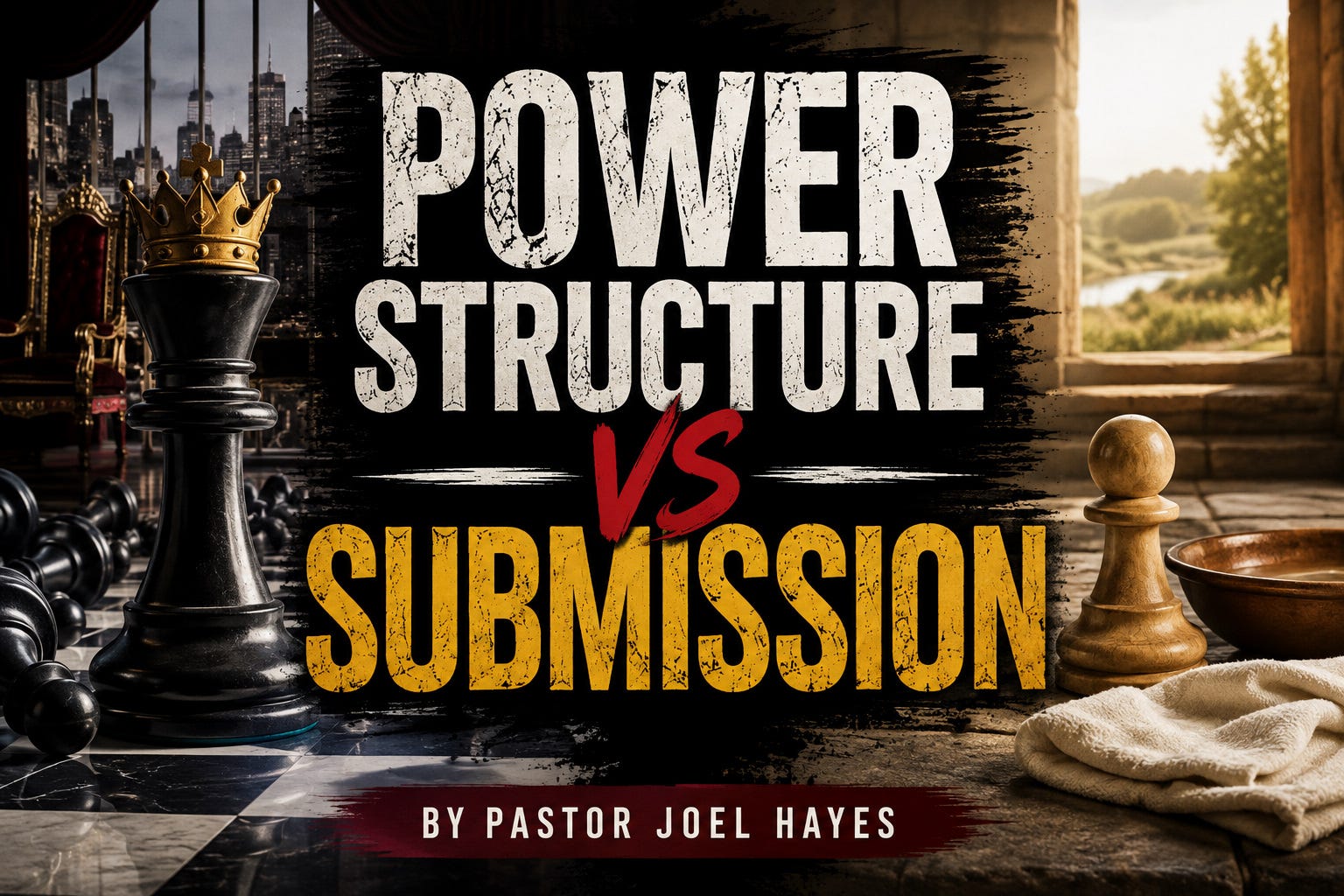
So how does everyone submit to each other while at the same time function in this framework of structured authority with leaders?
One of my favorite aspects about submission is that it totally forces you to take a deep dive at the Trinity (1 John 5:7), or the triune Godhead, and to really understand this relationship between power structures vs. equal submission.
I love how no one in the Godhead competes for authority or glory or recognition. Instead, they each live to continually honor and exalt the other members.
Let’s start with Christ. He said repeatedly, “I seek not mine own will, but the will of the Father which hath sent me” (John 5:30), and He said, “for my Father is greater than I” (John 14:28). Greater in authority, not a greater divine person.
But the also Father exalts the Son: The Father gives all authority to Christ (“This is my beloved Son, in whom I am well pleased; hear ye him”—Matt. 17:5). He bestows on Him “a name which is above every name” (Phil. 2:9).
And then you have the Spirit exalting both the Father and Son. A great example of this for me would be those verses in John 16:13-14. The Lord was explaining to the disciples how they’re going to speak the words of God at Pentecost. He said the Spirit “will not speak on his own authority, but whatever he hears he will speak... He will glorify me, for he will take what is mine and declare it to you.” He’s explaining the process of how Peter will be speaking the words of God at Pentecost. The Spirit will share what He hears in Heaven – the voice of one glorifying Christ. That’s not Christ Himself. That’s the Father. But, you see, the Spirit loves to serve and glorify the Father and Son without asserting Himself.
As a result the Father and Son, both exalt the Spirit. The Father sends the Spirit as the primary Agent of our spiritual renewal when we get saved, and the Spirit’s inspired Word is also magnified above His name (Psalm 138:2).
So we have this beautiful absence of competition in the Trinity. They’re all elevating the others above themselves.
1. The Father points to the Son.
2. The Son glorifies the Father.
3. The Spirit glorifies the Son and the Father.
4. The Father magnifies the Spirit’s work above His name.
5. The Son sends the Spirit into all of us to seal us.
Yet, within the Trinity, there is structure and order.
I’ve always called God the Father “the executive branch of the Godhead.” He’s the one basically in charge, isn’t He? Ephesians 1! But that doesn’t mean He is “more God” than the Son or the Spirit. He is simply the one who was designated to be the divine fountainhead of everything. Plus, everything in this age of grace was by the Father’s design according to all the grace that is in His nature.
As I like to say about the Godhead, “Everything is of the Father, by Jesus Christ, through the Spirit.” They are three who operate as one unit, one God.
Thus, the Father is, basically, in charge of everything. There is structure and order within the Godhead, and there is also at the same time willing, voluntary, happy submission by all the members of the Godhead out of love.
Power structure and authority establishes order - that’s it. It doesn’t establish worth of the person who is in charge. Remember how Paul says in 1 Cor. 15, “when all things shall be subdued unto him, then shall the Son also himself be subject unto him that put all things under him” (v. 28). And what is the final result? “that God may be all in all.” In the eternal state, Paul tells us the Son willingly subjects Himself to the Father and His eternal purpose for all of us. And the result is that God will be all in all – He’ll be in us and we’ll be in Him.
Even though the Father is in this position of penultimate authority and the Son is subject to the Father, that doesn’t erase their equality as divine beings. It simply means that both Father and Son have accepted this established hierarchy for the sake of keeping order in the kingdom of God.
Equality does not demand equal authority. Christ doesn’t see authority as defining His worth. For Christ, worth has nothing to do with position of authority. “He humbled himself, and became obedient unto death, even the death of the cross.” (Phil. 2:8) Then: “Wherefore God also hath highly exalted him, and given him a name which is above every name.” (v. 9)
There’s both equal submission and a power structure in the Trinity. The Son obeys. The Father exalts. Both are submitting. Both are elevating the others above themselves. What does the Father do with His authority? He uses it to exalt the Son. He also uses it to exalt the work of the Spirit and magnifies His Word above His name. And what does the Son do in His submission? He uses His role to exalt and glorify the Father. It’s not like there is equal submission, which means there’s no need for authority. The beauty of the Trinity is the absence of selfishness and the elevation of others within their established power structure and authority.
Not everybody submits to everybody else in the same way. The Father does not submit to the Son in the same way that the Son submits to the Father. Mutual love and submission does not mean identical roles. The Father, the Son, and the Spirit share the exact same divine nature, power, and glory, but they each occupy unique roles and submit and exalt the others in their own way within those roles.
The Son obeyed the Father. He did everything the Father told Him to do. But the Father exalted the Son and entrusted Him with all authority “The Father loveth the Son, and hath given all things into his hand” (John 3:35). The Father does not obey the Son in the way the Son obeys the Father. Yet the Father continually submits Himself by serving His Son, elevating His Son, from His position of authority. The Spirit has that same kind of relationship.
All three members of the Trinity have completely unique roles. Yet, in those unique roles, they universally submit and elevate the others above themselves.
That is our model.