

Introduction
Matthew 13 and Paul’s epistle to the Ephesians present two distinct administrations within the revealed purpose of God. They are not alternate expressions of the same doctrinal system, nor do they describe a unified program under different language. Rather, each belongs to a different sphere and must be interpreted according to its proper dispensational context.
Matthew 13 stands within the prophetic kingdom program promised to Israel. Its language is consistently earthly, covenantal, and related to the anticipated reign of Messiah. By contrast, the Epistle to the Ephesians reveals what Paul calls “the mystery,” a body of truth that had been hidden in God and not made known in previous ages.
Paul writes:
Ephesians 3:3–5 (KJV)
“How that by revelation he made known unto me the mystery…
Which in other ages was not made known unto the sons of men…”
This declaration establishes an essential interpretive boundary. If the mystery was not made known in other ages, it cannot be present—even in concealed form—in the teaching of Matthew 13. The two must therefore be distinguished rather than merged.
The unity of Scripture is preserved not by collapsing these programs into one, but by recognizing that God has revealed His purposes progressively. When each portion of Scripture is understood in its proper sphere, the result is not contradiction, but clarity.
Matthew 13 and the Kingdom in Mystery Form
Matthew 13 appears at a decisive turning point in the Gospel narrative. The preceding chapters record increasing rejection of the Lord Jesus Christ by the leadership of Israel, culminating in the charge that His works were performed by the power of Satan:
Matthew 12:24 (KJV)
“This fellow doth not cast out devils, but by Beelzebub the prince of the devils.”
In response to this rejection, the Lord begins to teach in parables. He explains the change in method:
Matthew 13:11 (KJV)
“Because it is given unto you to know the mysteries of the kingdom of heaven, but to them it is not given.”
These “mysteries” do not introduce a new doctrinal program. Rather, they reveal the kingdom in a concealed form during a period when its King is rejected. The kingdom is not abandoned, and its promises are not canceled. Instead, it’s open manifestation is delayed.
Thus, Matthew 13 describes not a new spiritual body, but the condition of the kingdom during this interim period.
The Parables as a Unified Presentation of the Kingdom
The parables of Matthew 13 must be understood collectively. Together they form a structured picture of the kingdom during its concealed phase.
To avoid misunderstanding, it must be emphasized that the parables of Matthew 13 do not describe anything taking place in the present dispensation of grace. Israel’s Kingdom is entirely in abeyance today, and no Kingdom conditions exist while the prophetic program is paused. These parables instead outline the future conditions of the Kingdom program during the King’s absence—conditions that began with His rejection, are completely suspended during the mystery revealed to Paul, and will resume only after the church is removed. Nothing in these parables applies to the Body of Christ or the present age; they belong exclusively to the Kingdom program that was offered, withheld, interrupted, and will one day be resumed.
The parable of the Sower establishes the nature of the message:
Matthew 13:19 (KJV)
“When any one heareth the word of the kingdom…”
The issue is the reception of the kingdom message in the Jewish world & prophetical timetable. There is no reference to the Church, the Body of Christ, or the heavenly position of believers. The focus remains consistently tied to the kingdom.
The parable of the wheat and tares provides the key interpretive anchor. Christ Himself defines its elements:
Matthew 13:38–39 (KJV)
“The field is the world… the harvest is the end of the world… and the reapers are the angels.”
This interpretation establishes firm boundaries. The field is not the Church but the world. The separation is not present but future. The agents of judgment are angels, not members of a spiritual body. The entire framework is eschatological and kingdom oriented.
This understanding governs the remaining parables.
Growth, Mixture, and Influence within the Kingdom
Following the central parable, the Lord does not describe the expansion of the kingdom during this concealed period, but rather its conditions within the world while the King is absent. The kingdom itself remains withheld, unrevealed, and unexpanded; what grows in this interval is the mixed and often misleading field of profession, not the kingdom promised to Israel.
The mustard seed illustrates outward development:
Matthew 13:31–32 (KJV)
“Which indeed is the least of all seeds: but when it is grown, it is the greatest among herbs, and becometh a tree…”
The mustard seed’s transformation into a tree does not depict the Kingdom expanding, but the abnormal outward swelling of the professing realm. Its oversized branches provide room for corrupting influences, symbolized by the birds that settle within it.
The parable of the leaven turns to internal influence:
Matthew 13:33 (KJV)
“The kingdom of heaven is like unto leaven… till the whole was leavened.”
In Scripture, leaven often represents a spreading influence, frequently associated with corruption:
1 Corinthians 5:6 (KJV)
“Know ye not that a little leaven leaveneth the whole lump?”
Taken together, these parables describe the conditions surrounding the Kingdom program during the King’s absence—marked by outward enlargement of the professing realm and the presence of corruption. They do not depict the Kingdom growing, nor do they apply to the present dispensation
The Treasure and the Value of the Kingdom
The following parable introduces imagery rooted directly in Old Testament identity:
Matthew 13:44 (KJV)
“The kingdom of heaven is like unto treasure hid in a field…”
The Old Testament provides a clear context for this imagery:
Psalm 135:4 (KJV)
“For the LORD hath chosen Jacob unto himself, and Israel for his peculiar treasure.”
This established identification suggests that the treasure corresponds to Israel as a people set apart by God. The hidden nature of the treasure in the parable aligns with the broader theme of the chapter: what is promised remains real and valuable, though presently concealed.
The parable of the pearl further emphasizes the value of the kingdom, reinforcing the worth of that which is secured, even during a period in which it is not fully manifested.
The final parable—the net—returns once more to the theme of separation:
Matthew 13:49 (KJV)
“The angels shall come forth, and sever the wicked from among the just.”
Again, the pattern is consistent: future judgment, angelic agency, and end-of-age fulfillment.
The Revelation of the Mystery in Ephesians
In contrast to Matthew 13, the Epistle to the Ephesians introduces a distinct and previously unrevealed program.
Paul writes:
Ephesians 3:2 (KJV)
“The dispensation of the grace of God which is given me to you-ward.”
This marks a change in divine administration. The content of this new dispensation is described clearly:
Ephesians 3:6 (KJV)
“That the Gentiles should be fellowheirs, and of the same body…”
This is not an expansion of the kingdom program. In prophecy, Gentiles are blessed through Israel. In Ephesians, Jew and Gentile are made one within a single body.
This new identity is further defined:
Ephesians 2:15 (KJV)
“For to make in himself of twain one new man…”
The distinctions that structure the prophetic program are removed. The unity described is not national, but spiritual. It is not covenantal, but positional.
This position is explicitly heavenly:
Ephesians 2:6 (KJV)
“And hath raised us up together, and made us sit together in heavenly places in Christ Jesus.”
Here the contrast becomes unmistakable. Matthew anticipates an earthly kingdom. Ephesians reveals a heavenly body.
Revelation and the Resumption of the Kingdom Program
The distinction between these programs is confirmed when the book of Revelation is considered.
Rather than developing the doctrine of the Body of Christ, Revelation returns to the categories of prophecy:
Revelation 7:4 (KJV)
“Of all the tribes of the children of Israel…”
Revelation 21:24 (KJV)
“And the nations of them which are saved shall walk in the light of it…”
These elements reflect the same framework found in the Old Testament and in Matthew 13: tribes, nations, earthly structure, and kingdom authority.
The language of “one new man” and heavenly seating is absent. Instead, the prophetic program resumes and is brought to completion.
Doctrinal Comparison:
Matthew 13: Kingdom of heaven.
Ephesians: Body of Christ.
Matthew 13: Earthly focus.
Ephesians: Heavenly position.
Matthew 13: Israel and nations distinct.
Ephesians: Jew and Gentile one.
Matthew 13: Mixed condition.
Ephesians: Spiritual unity.
Matthew 13: Judgment by angels.
Ephesians: Union by the Spirit.
The Integrated Flow of Scripture
When these distinctions are maintained, the structure of Scripture becomes clear:
Israel receives promises of an earthly kingdom.
Matthew 13 describes the kingdom during rejection.
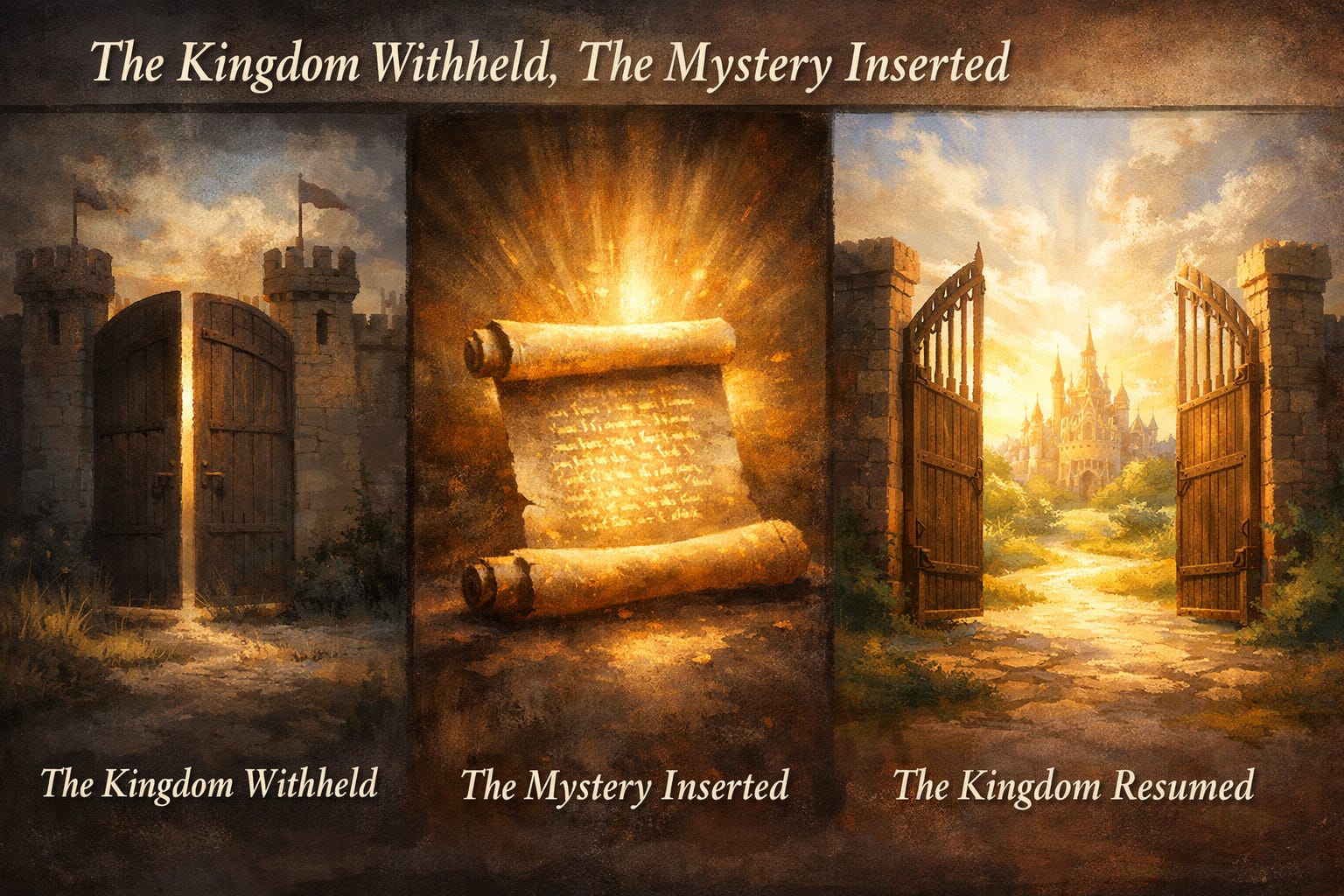
The kingdom is temporarily withheld.
The mystery is revealed through Paul.
The Body of Christ is formed.
The Kingdom Resumed — At the church’s departure, the Kingdom program resumes, and the epistles of Hebrews through Revelation become operative for Israel. Revelation then unveils the prophetic end‑time fulfillment of that resumed program in detailed sequence.
Each stage builds upon the last without confusion.
Final Synthesis
Matthew 13 presents the kingdom in its concealed form during the rejection of the King.
Ephesians reveals the previously hidden truth of the Church, the Body of Christ.
Revelation unveils the Day of the Lord and the end‑time fulfillment of the prophetic kingdom program.
These are not competing systems, but successive administrations in the unfolding purpose of God.
The kingdom is not the Body.
The Body is not the kingdom.
The kingdom is withheld, not canceled.
The mystery is inserted, not predicted.
The kingdom is resumed, not replaced.
2 Timothy 2:15 (KJV)
“Study to shew thyself approved unto God… rightly dividing the word of truth.”
A great article. Tanx brother Hal.
Yes! “Therefore if any man be in Christ, he is a new creature: old things are passed away; behold, all things are become new”. 2Cor.5:17