

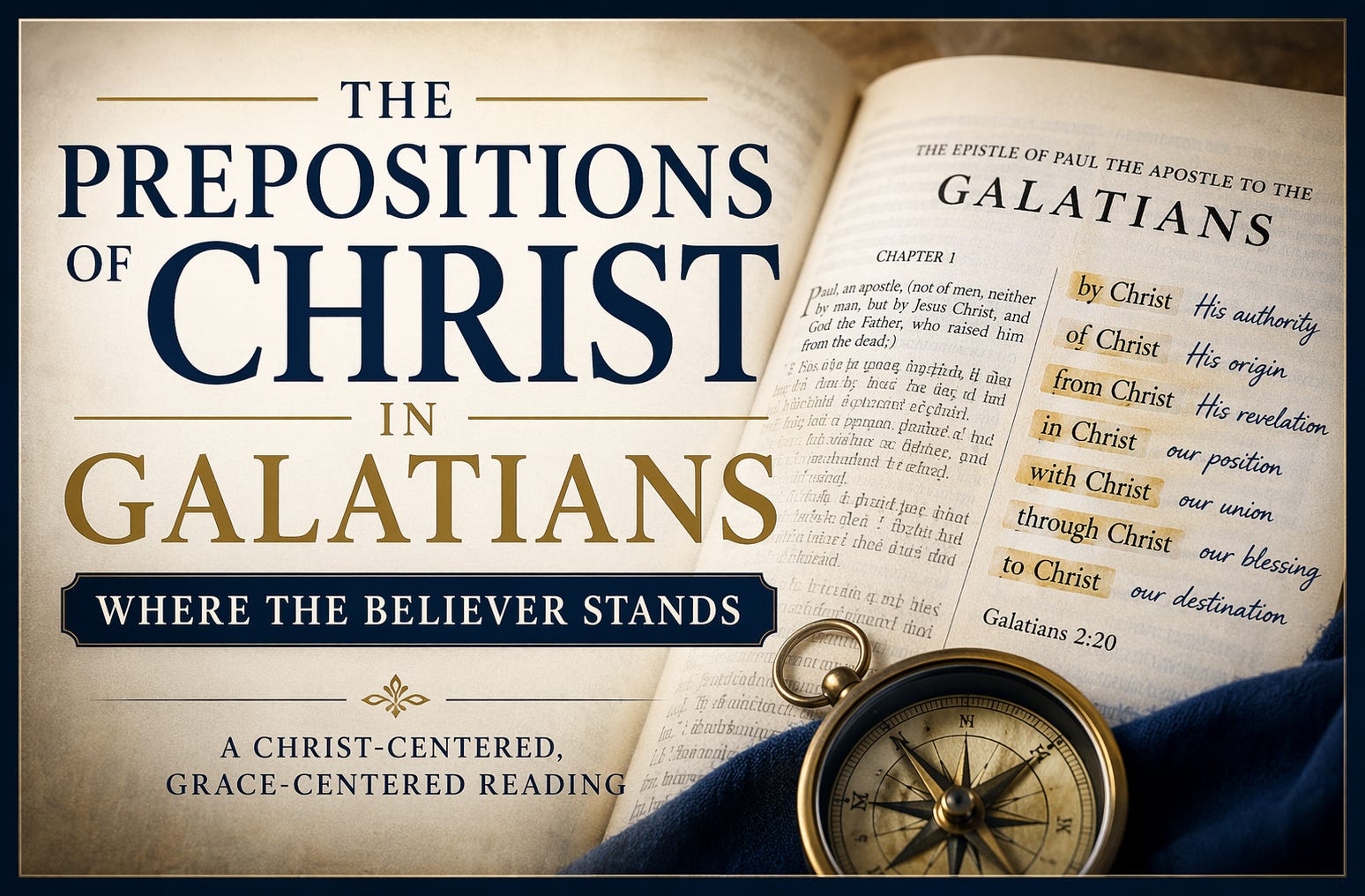
There are certain words in Scripture that appear small at first glance, yet they carry enormous theological weight once we slow down enough to consider them. Prepositions are among those words. They are easily overlooked because they are brief, familiar, and woven into the fabric of ordinary speech. Yet in the writings of the apostle Paul, these small words quietly bear the structure of the gospel itself. They do not simply connect ideas; they locate the believer in relation to Christ.
The Epistle to the Galatians is a fitting place to trace this reality. Galatians is not written in calm detachment. It is written in urgency. The gospel preached among the Galatians had been disturbed by false teachers who sought to add the works of the law to the finished work of Christ. What was at stake was not a minor doctrinal nuance but the very nature of salvation.
Paul responds by bringing everything back to Christ. Again and again, his language reveals that Christ is not an accessory to salvation—He is its center, its source, its means, and its end. When we pay attention to Paul’s prepositions, we begin to see the argument unfold with clarity. Christ is the one by whom, from whom, in whom, with whom, through whom, and ultimately to whom all things in salvation belong.
These prepositions answer the most important question of all: Where does the believer stand?
BY CHRIST — THE AUTHORITY OF OUR SALVATION
Paul opens the letter with a striking declaration: “Paul, an apostle, not of men, neither by man, but by Jesus Christ, and God the Father” (Galatians 1:1). From the beginning, the apostle removes all possibility that his authority is derived from human origin or human mediation. His apostleship is by Christ.
This is more than a statement about Paul; it establishes the authority of his message. If his apostleship is by Christ, then the gospel he preaches bears divine authority. It is not subject to revision, negotiation, or improvement by human systems. It comes with the authority of the One who sent him.
This same principle extends to salvation itself. In Galatians 2:17, justification is bound up with Christ as the acting agent. Salvation is not something achieved by human effort and then affirmed by Christ. It is accomplished by Christ. He is the one who acts.
This cuts directly against the instinct of legalism. Legalism always attempts to shift the center of gravity from Christ’s action to human performance. It asks, “what must I do to establish my standing?” Paul answers by pointing back to Christ. Salvation is by Him. Its authority rests in Him.
Because it is by Christ, it is final. Because it is by Christ, it is not dependent on fluctuating human ability. And because it is by Christ, it stands secure beyond the reach of human amendment.
OF CHRIST — THE SOURCE AND OWNERSHIP OF OUR FAITH AND WALK
Paul next speaks of what is “of Christ.” He refers to “the gospel of Christ” (Galatians 1:7), “the faith of the Son of God” (Galatians 2:20), and “the law of Christ” (Galatians 6:2).
The gospel is of Christ. It originates in Him. It does not arise from tradition, culture, or religious development. It is not a humanly constructed message about how to reach God. It is Christ’s gospel—rooted in His person and His work.
When Paul warns that some are troubling the Galatians by perverting the gospel (Galatians 1:7), he is not concerned about a minor distortion. To alter the gospel is to tamper with something that belongs to Christ Himself.
The phrase “the faith of the Son of God” deepens this further. The believer lives by faith, yet that faith rests on Christ’s own faithfulness—His obedience, His righteousness, His perfect fulfillment of the Father’s will. The believer’s confidence is not grounded in the strength of his faith, but in the reliability of the Son who loved him and gave Himself for him.
Even the ethical outworking of the Christian life is described as “the law of Christ” (Galatians 6:2). This is not a return to Mosaic bondage, but the expression of Christ’s own character—especially love—worked out through the Spirit. The believer’s life reflects Christ because it flows from Christ.
Everything in the Christian life is of Him. Its origin, its power, and its direction all belong to Him. This shifts confidence away from the believer’s performance and firmly onto Christ’s sufficiency.
FROM CHRIST — THE REVELATION AND BLESSING WE RECEIVE
Paul insists that the message he proclaims was not learned from men: “I neither received it of man… but by the revelation of Jesus Christ” (Galatians 1:12). His gospel came from Christ.
This establishes the source of truth. The gospel is not something gradually discovered through human reflection. It is revealed. Christ Himself discloses it.
This same pattern appears in the reception of the Spirit. In Galatians 3:14, Paul explains that the promise of the Spirit comes through Christ and is received by faith. The Spirit is not earned through law-keeping. He is given.
Paul presses this point by asking, “Received ye the Spirit by the works of the law, or by the hearing of faith?” (Galatians 3:2). The answer is clear. The Spirit comes as gift, it is not earned by self-merit.
This reshapes how the believer understands the Christian life. We do not construct grace; we receive it. We do not generate spiritual life through effort; we live from what Christ gives. What comes from Christ carries His authority and His sufficiency.
IN CHRIST — THE POSITION OF THE BELIEVER
Perhaps no phrase is more central than this: “in Christ.” Paul uses it to describe the believer’s standing.
There is liberty in Christ (Galatians 2:4), justification in Christ (Galatians 2:16), and sonship in Christ (Galatians 3:26). The believer’s entire identity is located in Him.
In Galatians 3:26–28, Paul declares that all who believe are sons of God by faith in Christ Jesus. In Him, divisions that once defined religious standing lose their power: Jew and Gentile, slave and free, male and female—all are one in Christ.
This is not the erasure of human distinctions in every sense, but the removal of those distinctions as grounds of acceptance before God. No one is closer to God on the basis of heritage, status, or religious markers. All stand equally in Christ.
To be in Christ is to occupy a position secured by grace. The believer is not striving to enter this position; he has been placed there. His identity does not rest in his past, his performance, or his progress, but in Christ Himself.
WITH CHRIST — OUR UNION IN HIS DEATH AND LIFE
Paul’s words in Galatians 2:20 bring us into the heart of union with Christ: “I am crucified with Christ.”
This is more than language of association; it is language of participation. The believer has been united to Christ in His death. The old man—our self that is defined by sin and striving under the law—has been judged.
“Nevertheless I live; yet not I, but Christ liveth in me.”
The Christian life is not the old self improved; it is the new life imparted. Christ lives in the believer. His life becomes the animating power of the believer’s existence.
“And the life which I now live… I live by the faith of the Son of God, who loved me, and gave himself for me.”
This is intensely personal. Christ’s love is not abstract—it is directed. His self-giving was for me.
Galatians 5:24-25 confirms this pattern: those who are Christ’s have crucified the flesh. Sanctification flows from union. It is not self-manufactured holiness but the outworking of life with Christ.
THROUGH CHRIST — THE CHANNEL OF ALL BLESSING
In Galatians 3:14, Paul writes that the blessing comes “through Jesus Christ.” Every spiritual blessing reaches the believer through Him.
The promise to Abraham is fulfilled through Christ. The Spirit is given through Christ. Our inheritance is secured through Christ.
Nothing flows through the law in this way. The law cannot justify, cannot give life, and cannot secure the promise. It never could - Its role is different.
Paul’s question in Galatians 3:3 exposes the error of the Galatians: “Are ye so foolish? having begun in the Spirit, are ye now made perfect by the flesh?” Grace does not begin with Christ and continue through self-effort. It flows entirely through Him.
There is no secondary channel. Christ is not supplemented. He is sufficient.
TO CHRIST — THE DIRECTION AND DESTINATION OF THE LAW
Finally, the law is described in terms of direction: it brings us to Christ (Galatians 3:24).
The law functions as a guide. It exposes sin, reveals need, and points forward. But it never had the power to be the means of justification.
Once Christ has come, and once faith has laid hold of Him, the believer is no longer under the law in that same sense. The tutor has fulfilled its role.
“And they that are Christ’s…” (Galatians 5:24)
Those who have been brought to Christ now belong to Christ.
The law drives the sinner to him by revealing his unworthiness. Grace anchors the believer in him by the sufficiency that is only found in Christ.
CONCLUSION — THE PREPOSITIONAL GOSPEL OF GRACE
Taken together, these prepositions form a unified picture of the gospel:
By Christ — His authority
Of Christ — His origin
From Christ — His revelation
In Christ — our position
With Christ — our union
Through Christ — our blessing
To Christ — our destination
This is Paul’s gospel. Christ is not part of salvation—He is its entirety.
Therefore, as believers we must reject every return to the law as the basis of our justification and a worthy walk, stand confidently in our identity in Christ, and walk in the liberty that grace has already secured.