

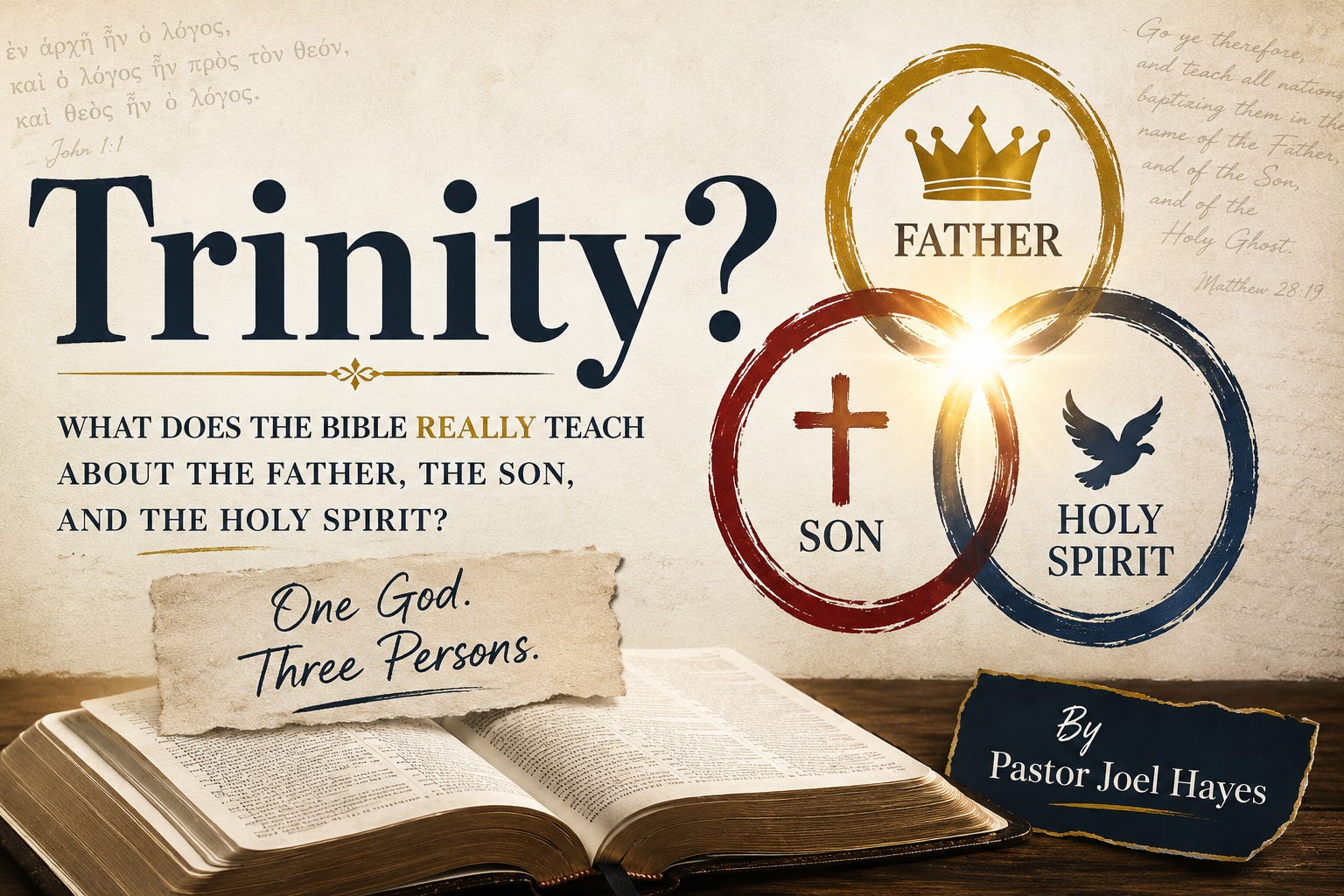
Oh my. There has been a brewing controversy for a while in the grace movement over the doctrine of “the Trinity.” This comes as news to no one, I’m sure, and I suspect this controversy probably exists in Christendom generally.
Let’s defend the doctrine of the Trinity, shall we?
THE WORD “TRINITY”
I noticed that some of these anti-trinitarian saints like to post these rather in-your-face combative statements online declaring that the trinity is heresy, and there is no “trinity” in your Bible. As if to say that the doctrine of “trinity” doesn’t exist in the Bible because the word “trinity” doesn’t exist in the Bible.
Do you know what else doesn’t exist in your Bible?
The word “Bible.”
Show me chapter and verse where God says “Bible” in your Bible. How can anyone say that something isn’t a Bible word when the word “Bible” doesn’t exist in your Bible? That is a title added by the translators to God’s holy “word” or “scriptures.” Yet, Bible is a perfectly acceptable word, which means sacred volume.
I’d say that’s a pretty accurate word to precisely describe His scriptures, wouldn’t you agree? This glorious book truly is a sacred volume, a holy collection of writings inspired by the Spirit that reveals God to us.
In the same sense, “Trinity” is a perfectly accurate word to precisely describe the union of three persons in one Godhead - the Father, the Son, and the Holy Spirit.
THE FATHER – SON RELATIONSHIP
I once read some anti-trinitarians (Partialists - 1 God made up of 3 parts) argue for a body–soul–spirit analogy. They said that man is 1 person with 3 parts that are distinct (body, soul, spirit) according to 1 Thess. 5:23. And the argument goes that the distinction in these parts is not the same as multiple persons.
I would absolutely agree with every word of that argument.
However, in Scripture, the triune Godhead goes way beyond some meager comparison to a person’s body, soul, and spirit. A soul does not pray to the body, like the way Christ prayed to the Father. A body does not send a soul, like the way the Father sends the Spirit. God presents Himself to us in Scripture as Father, Son, Spirit (Matt. 28:19). The Father is called God (Rom. 1:7). The Son is called God (Heb. 1:8), and the Spirit is called God (Acts 5:3-4).
Let’s consider the Father / Son relationship. How can anyone not view a father and a son as distinct persons? A typical father and son on earth are distinct persons that have a relationship in a family, do they not?
No father and son will ever be – one person. They are two independent, distinct people with separate wills in a relationship defined by family.
God knew perfectly well that we’d view the Father and the Son as distinct persons with separate wills in the same family, because a father and a son on earth are distinct persons with separate wills in a family.
How can this not be intentional on God’s part?
Did you ever notice how the Son submits His will to the will of His Father in Heaven? The Lord said in Luke 22:42, “Father, if thou be willing, remove this cup from me: nevertheless not my will, but thine, be done.” (See also John 5:30, 6:38, Matthew 26:39, Matthew 26:42, John 4:34, John 8:29, John 14:31, Philippians 2:8, and Hebrews 10:7, 9.)
There are separate wills being contrasted in the Lord’s prayer.
Traditionally, people would explain this conflict of wills as the Son submitting His human will to the divine will of the Father. You still have separate wills. But I would also suggest that two sinless, holy persons can have differing ideas about how to accomplish things. Do you remember how the Lord invited sinless angels to give Him different ideas about how to kill Ahab in 1 Kings 22:19-23?
Just because you’re sinless and holy doesn’t mean that you don’t have different ideas than another sinless and holy person.
Wouldn’t separate wills indicate distinctly unique persons?
The issue isn’t whether one person can have differing components to his being. Of course, he can! The issue is - does scripture portray Father, Son, and Holy Ghost merely as parts of one person? It absolutely does not.
· The Father loves the Son (John 3:35; 5:20).
· The Son loves the Father (John 14:31).
· The Father sends the Son (John 5:37).
· The Son comes from the Father (John 16:28).
· The Son prays to the Father (John 17).
· The Father glorifies the Son (John 17:5).
· The Son glorifies the Father (John 17:4).
· The Spirit speaks concerning the Son and glorifies Him (John 16:13–14).
· The Son sends the Spirit from the Father (John 15:26).
Does this list not scream volition? Free will? Agency? Independence? These are the actions and relationships between distinct divine persons, are they not?
THE LORD’S BAPTISM
When the Lord was water baptized in Matthew 3:16–17, He is physically standing in the Jordan river. The Spirit descends upon Him as a dove. The Father’s voice comes from heaven: “This is my beloved Son, in whom I am well pleased.”
All three are simultaneously present and totally distinct in that moment. How can this be three parts of one person? How does this even remotely compare to the body-soul-spirit analogy?
More importantly, the Father doesn’t say: “This is another manifestation / component / aspect of Me.”
He says: “my beloved Son.”
Again, a Father / Son relationship, which compels us to view them as distinct.
JOHN 1:1
How can we not think of John 1:1? “In the beginning was the Word, and the Word was with God, and the Word was God.”
He was with God, and He was God.
Christ is the Word, logos. Just as words reveal hidden thoughts, Christ came into this world to reveal the hidden God, and Christ Himself is the Living Word of the living God, the one who spoke the words of the Father, revealing to us the very hidden thoughts of the Father for us. He said, “I do nothing of myself; but as my Father hath taught me, I speak these things” (Joh 8:28).
Let me ask a question: is the Living Word the Lord Jesus Christ or the words He spoke or the words in the Bible?
Yes.
John says, “Word was with God, and the Word was God.” He’s saying that Christ was WITH God and He WAS God.
How can He be God and WITH God at the same time?
How do you explain the preposition “with?” I’d argue that “with” in John 1:1 has only one solution - with indicates both equality, distinction of identity, along with unity. In other words, He was “face to face with God.” Christ was face-to-face with God the Father. He was equal to God. He was in perfect oneness with Him, yet distinct. Christ, the “Word,” is deity, eternal, one with God, co-equal with God, face to face with God the Father, yet distinct. We have eternal coexistence, eternal equality, eternal oneness, and eternal unity of God with God.
BIBLICAL ONENESS
To me, a debate about Trinity is really about Biblical oneness.
Oneness in the Bible is not necessarily sameness of person. “One” does not always mean “one person.” Biblical oneness can describe a genuine unity among genuinely distinct persons. Like Marriage. Like the Body of Christ.
Marriage
In Genesis 2:24, man and woman become “one flesh” –- a compound unity – more than one distinct entity brought into a new unified reality. Christ makes the distinction even more explicit in Matthew 19:5–6. He says, “...they twain shall be one flesh... Wherefore they are no more twain, but one flesh.” Jesus doesn’t deny that they are two persons. In fact, He explicitly calls them “twain.” Yet those two are simultaneously called “one.”
So when the Bible calls two people “one,” does that mean the husband and wife suddenly become one physical human being made up of two parts? Of course not. Their distinction remains. She can speak to him. He can speak to her. He can love her. She can love him back. Or not. LOL They are one, but they remain distinct.
Scripture teaches us that oneness can exist with distinct persons brought together. That is true Biblical Oneness. That is practically being ignored in all of this Trinity controversy.
The Body of Christ (1 Cor. 12:12–13)
Paul teaches oneness in the Body of Christ while all of us members remain distinct. In partialism, the body, soul, and spirit are sub-components of one individual. But in 1 Corinthians 12, the members are full individuals baptized into one new collective reality.
Paul says: “For as the body is one, and hath many members, and all the members of that one body, being many, are one body: so also is Christ.” (1 Cor. 12:12)
Notice how deliberately Paul holds together two concepts: ONE — MANY — ONE.
And then verse 13, “For by one Spirit are we all baptized into one body...”
Then verse 14, “For the body is not one member, but many.”
This is practically tailor-made to illustrate Biblical Oneness. Paul does not say: Because the body is one, its members can no longer be distinct. He says, “the body is not one member, but many.” Yet all those many constitute “one body.”
A FAVORITE POINT
Here’s a favorite argument of mine. Consider this. Jesus is praying in John 17:21, and he says, “That they all may be one; as thou, Father, art in me, and I in thee, that they also may be one in us...”
Notice what He says here. Jesus uses the unity of the Godhead as a kind of baseline for how He wanted to see distinct believers united. If the Godhead was like one person with a body, soul, and spirit, then the Lord’s prayer would make absolutely no sense — believers cannot become one new physical being. They can, however, share absolute unity of purpose, nature, and love while remaining distinct persons - just like the Trinity.
Biblical Oneness is all about unity that can exist with distinct persons who are brought together.
1 JOHN 5:7
“For there are three that bear record in heaven, the Father, the Word, and the Holy Ghost: and these three are one.”
Every anti-trinitarian argument fails to adequately explain 1 John 5:7.
I once read that 1 John 5:7 is not really about the makeup of the Godhead. This is more about establishing legal testimony (”witness”). Because verse 8 talks about water, blood, and Spirit as non-person earthly witnesses, then these three heavenly witnesses in verse 7 somehow does not imply that there are three distinct divine Persons.
What are you talking about?
Verse 7 says the heavenly three “ARE ONE” (unified, one being as three persons). Verse 8 says the earthly three “AGREE IN ONE” (agreement toward a singular goal).
Things that are different are not the same.
Do you not remember how the law of Moses required two or three witnesses to establish a truth? This is in Deut. 19:15. A witness isn’t one person made up of three parts. Two or three witnesses are two or three distinct individuals.
A witness has to possess independent, personal agency in order to be a true witness, and 1 John was written to refute heresies that denied the true nature and identity of Jesus Christ (1 John 2:22, “Who is a liar but he that denieth that Jesus is the Christ? He is antichrist, that denieth the Father and the Son.” Is not the Father and Son distinct individuals here?)
Verse 6 sets up the record: the Spirit bears witness because the Spirit is truth. Verse 9 states that this record is “the witness of God which he hath testified of his Son.” Those are two distinct witnesses, as reflected in Deut. 19. When John was writing about witnesses, every Jew reading this very epistle knew that the law required two or three distinct witnesses as the legal standard to establish a truth.
John is fulfilling that Mosaic legal standard by declaring the distinct witnesses of the Father and the Spirit that Jesus is the Christ. That’s the point here. This threefold testimony fits naturally within their legal guidelines of two or three witnesses. The Father and the Spirit have to be distinct to satisfy the Mosaic standard of establishing a truth.
Yet, they ARE ONE. This is one Being as three distinct Persons. The three operate together as one unit with the same divine essence / nature.
PUSHBACK
On the podcast, the argument to this view I shared about 1 John 5:7 is that God used rocks as witnesses in Joshua 24:27. Tell me something - if a Jew was on trial before the Sanhedrin Council, do you think he could bring in some rocks, line them up on a table, and say, “Here you go! These are my witnesses!” How well do you think that is going to go over?
What was going on in Joshua 24? We have the final address of Joshua to the gathered tribes of Israel at Shechem. After reminding them of God’s faithfulness from the calling of Abraham through the conquest of Canaan, Joshua demands a covenant decision: “choose you this day whom ye will serve” (v. 15). The people respond three times promising to serve the LORD (vv. 16, 21, 24). Joshua cuts a formal covenant with them, writes the words in the book of the law of God, and takes a great stone to set it up under an oak by the sanctuary of the LORD (v. 26). Verse 27 was just the formal ratifying of the covenant.
The stone served as nothing more than a memorial to a moment in time, a silent reminder of the solemn oaths and the covenant that was made.
The rock cannot testify of a truth that Christ is the Son of God like the Father and the Spirit can testify as witnesses in 1 John 5:7. The Father, Son, and Spirit are not inanimate objects. You can metaphorically say a stone “heard” a speech, but a stone cannot pray, love, or commission someone to go on a mission like the Father, Son, and Spirit. The stone as a memorial isn’t even remotely similar to the law of two or three witnesses in Deut. 19.
The rock does nothing more than bear record simply by existing as historical evidence of an event. The Father, Word, and Spirit are active persons. The Father speaks from heaven. The Son dies on a cross and resurrects, and the Spirit indwells believers. They are not passive tokens of a moment in time like rocks.
They are active, personal, distinct participants as witnesses.
CONCLUSION
Of a truth Scripture is abundantly clear - God is one Being (one divine essence / nature) existing eternally as three distinct Persons.