

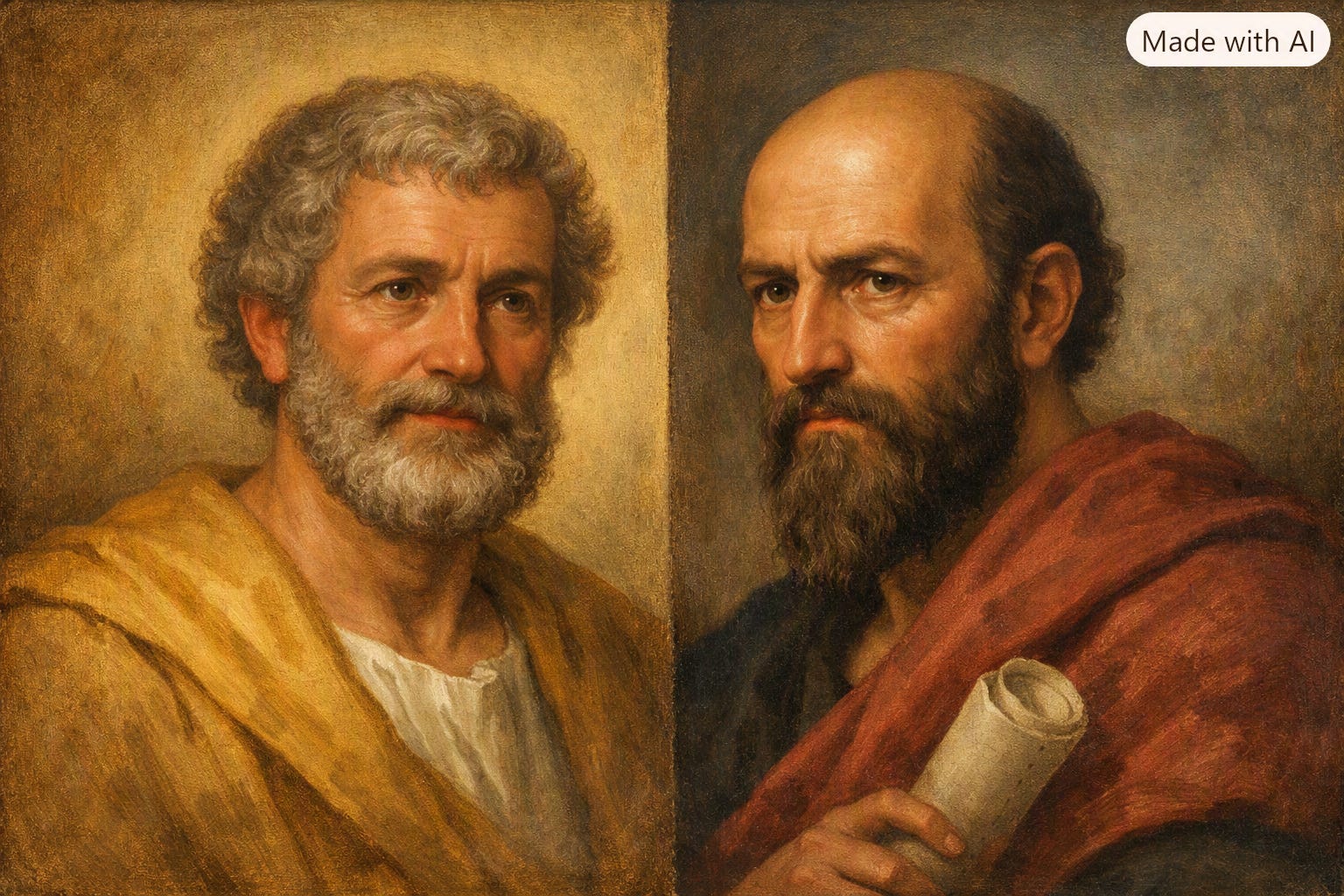
Peter, Paul, Faith, Works, and the Importance of Right Division
The following is adapted from a chapter in a book project I am presently developing on the distinctive apostleship and gospel committed to Paul. One of the purposes of that project is to examine not only where Paul’s message differs from what preceded it, but also where Scripture requires us to recognize continuity. Distinction should never be manufactured merely for the sake of making Paul different.
The confrontation between Peter and Paul in Galatians 2 provides a particularly revealing test case. It raises a question I believe deserves more attention than it commonly receives:
What did the man who preached Acts 2:38 know about justification?
Few doctrines stand nearer the heart of Paul’s gospel than justification.
“Therefore being justified by faith, we have peace with God through our Lord Jesus Christ:”
— Romans 5:1
Yet precisely because justification occupies such a prominent place in Paul’s writings, it is tempting to assume that justification by faith itself must have originated with Paul’s revelation.
That conclusion goes farther than Scripture allows.
Paul unquestionably reveals dimensions of justification inseparably connected with the gospel committed to him. He explains the Cross as the righteous ground upon which God justifies the ungodly. He declares justification to be freely by God’s grace through the redemption that is in Christ Jesus. He connects Christ’s resurrection with our justification and unfolds the believer’s standing in Christ apart from the works of the Law.
But Paul did not introduce faith into God’s dealings with man.
Nor did he reveal for the first time that human works possess no merit by which a sinner can establish righteousness before God.
That distinction is essential.
What is distinctive about Paul’s gospel must be determined by revelation, not by our need to make Paul different.
And perhaps no passage demonstrates that principle more clearly than a confrontation between two apostles in Antioch.
WHEN PAUL WITHSTOOD PETER
Galatians 2 records one of the most remarkable confrontations in the New Testament.
Paul writes:
“But when Peter was come to Antioch, I withstood him to the face, because he was to be blamed.”
— Galatians 2:11
Peter had been eating with Gentiles.
That fact itself is significant.
He was not living in complete separation from them according to the traditional Jewish pattern. Something had changed in Peter’s understanding and practice.
But when certain men came from James:
“he withdrew and separated himself, fearing them which were of the circumcision.”
— Galatians 2:12
Peter’s actions affected others:
“And the other Jews dissembled likewise with him; insomuch that Barnabas also was carried away with their dissimulation.”
— Galatians 2:13
Paul recognized that considerably more was at stake than where Peter chose to eat.
“But when I saw that they walked not uprightly according to the truth of the gospel...”
— Galatians 2:14
Peter’s conduct was communicating something contrary to the truth of the gospel.
Paul therefore confronted him publicly:
“If thou, being a Jew, livest after the manner of Gentiles, and not as do the Jews, why compellest thou the Gentiles to live as do the Jews?”
— Galatians 2:14
Then Paul says something extraordinarily important:
“We who are Jews by nature, and not sinners of the Gentiles,
Knowing that a man is not justified by the works of the law, but by the faith of Jesus Christ...”
— Galatians 2:15–16
Notice the language.
“We.”
And:
“Knowing.”
Paul does not say:
Peter, I am about to reveal something you could never previously have known.
He appeals to something they know.
“We who are Jews by nature...”
“Knowing...”
Peter’s conduct was inconsistent with Paul’s gospel, but Paul’s rebuke appeals to a principle concerning justification that Peter already understood.
That observation deserves considerable weight.
Peter knew the Law.
Peter knew circumcision.
Peter knew Israel’s covenant requirements.
Peter had preached repentance.
Peter had preached water baptism.
Yet Paul could address that same Peter and say:
“We...knowing that a man is not justified by the works of the law.”
This raises an important question.
WHAT DID THE MAN WHO PREACHED ACTS 2:38 KNOW ABOUT JUSTIFICATION?
Peter had stood before Israel on the day of Pentecost and declared:
“Repent, and be baptized every one of you in the name of Jesus Christ for the remission of sins...”
— Acts 2:38
Whatever interpretation we give those words, we must permit them to say what they say.
Peter required repentance.
Peter required baptism.
He connected that response with remission of sins and the promised gift of the Holy Ghost.
We should not weaken Peter’s words merely because they differ from the terminology of Paul’s later ministry.
But neither should we interpret Peter’s requirements in a manner that forces Peter to believe something Scripture tells us he knew was false.
The Peter who preached Acts 2:38 is the Peter to whom Paul could say:
“We...knowing that a man is not justified by the works of the law.”
Galatians 2 therefore provides an important interpretive control.
It does not rewrite Acts 2.
It does not turn Peter’s message into Paul’s gospel.
It does not make water baptism optional within Peter’s proclamation.
Rather, it establishes a boundary around what we may reasonably conclude Peter believed about the relationship between works and justification.
A later passage need not change the meaning of an earlier passage in order to place boundaries around interpretations of that earlier passage.
And here the connection is particularly compelling because we are dealing with the same man.
Acts 2 tells us what Peter preached.
Galatians 2 tells us something about what the man who preached it knew concerning justification.
That distinction protects us from two opposite errors.
We need not make Peter’s gospel Paul’s gospel.
And we need not make Peter a preacher of meritorious justification in order to preserve the distinctiveness of Paul.
The answer is not to make Peter’s message Pauline, nor to make Peter’s justification meritorious. It is to understand Peter’s requirements within the purpose and administration in which God gave them.
AN INDIVIDUAL RESPONSE WITHIN A NATIONAL APPEAL
Acts 2:38 does not occur in a vacuum.
Peter’s audience is identified repeatedly.
“Ye men of Judaea...”
— Acts 2:14
“Ye men of Israel, hear these words...”
— Acts 2:22
His indictment concerns Israel’s rejection of her Messiah:
“Jesus of Nazareth...ye have taken, and by wicked hands have crucified and slain.”
— Acts 2:22–23
Peter then connects Christ’s resurrection with the Davidic promise:
“Therefore being a prophet, and knowing that God had sworn with an oath to him, that of the fruit of his loins...he would raise up Christ to sit on his throne;
He seeing this before spake of the resurrection of Christ...”
— Acts 2:30–31
Then Peter brings the indictment home:
“Therefore let all the house of Israel know assuredly, that God hath made that same Jesus, whom ye have crucified, both Lord and Christ.”
— Acts 2:36
Only then comes the question:
“Men and brethren, what shall we do?”
— Acts 2:37
Peter’s answer must be understood in relation to the question.
Israel had rejected her Messiah.
God had raised Him from the dead.
The resurrection vindicated the very Christ whom the nation had crucified.
What were believing Israelites now to do?
“Repent, and be baptized every one of you...”
The appeal is national in its setting, but personal in its response.
That distinction matters.
A national message can demand an individual response without becoming merely an individual message.
Peter says:
“every one of you.”
Individual Israelites had to respond.
But the fact that individuals responded does not erase the corporate context from which the appeal arose.
Peter continues:
“And with many other words did he testify and exhort, saying, Save yourselves from this untoward generation.”
— Acts 2:40
The believing Israelite was called to separate himself from the unbelieving generation that had rejected Messiah.
Acts 3 confirms the same framework.
Peter again addresses:
“Ye men of Israel...”
— Acts 3:12
Again he rehearses their rejection:
“But ye denied the Holy One and the Just...”
— Acts 3:14
And:
“And killed the Prince of life, whom God hath raised from the dead...”
— Acts 3:15
Then comes the appeal:
“Repent ye therefore, and be converted, that your sins may be blotted out...”
— Acts 3:19
The passage immediately proceeds into the times of refreshing, the return of Christ, “the restitution of all things,” the prophets, Abraham, and finally:
“Ye are the children of the prophets, and of the covenant which God made with our fathers...”
— Acts 3:25
The setting is unmistakable.
Peter’s message belongs to Israel’s prophetic and covenantal expectation.
Individuals must respond, but they respond within a national program.
REQUIRED DOES NOT MEAN MERITORIOUS
This distinction helps us understand the place of works and obedience in Israel’s program.
God gave Israel real requirements.
Circumcision was required.
The Law contained real commandments.
John’s baptism was not presented as an optional ceremony.
Peter’s command to repent and be baptized was not merely a suggestion.
Faithful interpretation must allow those requirements to retain their force.
But a requirement is not necessarily a merit.
A work can be required without being meritorious.
That distinction is easily lost.
When God commanded an Israelite to do something, obedience mattered. Israel’s covenant life contained genuine conditions concerning blessing, chastisement, deliverance, possession, restoration, and participation in the promises made to the nation.
The Old Testament repeatedly contains the language of condition:
If...then.
That conditional structure was real.
But it does not follow that every required act supplied some portion of the righteousness by which an individual sinner was justified before God.
The distinction between requirement and merit must be maintained.
Neither should we say that the requirements were unimportant because “faith was all that mattered.”
That would create another error.
Faith believes what God says.
If God commands a particular response within the revelation He has given, faith cannot dismiss that response while claiming to believe Him.
Thus:
Because faith responds to revelation, the required expression of faith may differ as revelation and administration differ; but the expression of faith must never be confused with the meritorious ground of justification.
This allows the dispensational differences to remain genuine without transforming earlier administrations into systems in which sinners earned righteousness.
ISRAEL’S NATIONAL SALVATION
Luke’s account of Zacharias provides an excellent example of the national dimension of Israel’s salvation.
Filled with the Holy Ghost, Zacharias prophesied:
“Blessed be the Lord God of Israel; for he hath visited and redeemed his people,
And hath raised up an horn of salvation for us in the house of his servant David;”
— Luke 1:68–69
What salvation does he anticipate?
“That we should be saved from our enemies, and from the hand of all that hate us;
To perform the mercy promised to our fathers, and to remember his holy covenant;
The oath which he sware to our father Abraham...”
— Luke 1:71–73
This is plainly more than an abstract statement concerning the individual sinner’s justification.
Israel’s redemption included national deliverance.
It involved enemies.
It involved covenant.
It involved promises to the fathers.
It involved the house of David.
It involved the nation serving God:
“In holiness and righteousness before him, all the days of our life.”
— Luke 1:75
Israel therefore encountered salvation language in a context where personal faith, covenant obedience, national blessing, deliverance, and prophetic expectation stood together.
If those categories are indiscriminately collapsed, works associated with Israel’s covenantal program can easily be mistaken for the meritorious basis of personal justification.
Paul helps us separate them.
And remarkably, he does so by returning to men who lived long before his apostleship.
ABRAHAM BELIEVED GOD
Paul asks:
“For what saith the scripture? Abraham believed God, and it was counted unto him for righteousness.”
— Romans 4:3
Abraham did many things in obedience to God.
He left his homeland.
He received circumcision.
He offered Isaac.
His life was marked by acts of obedience arising from faith.
Yet when Paul asks how righteousness was counted to Abraham, his answer is not:
Abraham earned it.
It is:
“Abraham believed God.”
Paul immediately draws the distinction:
“Now to him that worketh is the reward not reckoned of grace, but of debt.”
— Romans 4:4
If righteousness were earned, God would owe it.
That is precisely what Paul denies.
Then:
“But to him that worketh not, but believeth on him that justifieth the ungodly, his faith is counted for righteousness.”
— Romans 4:5
Abraham’s works were real.
His obedience was real.
But his works were not the meritorious basis upon which God counted him righteous.
And Abraham is especially useful because he lived before the Law.
But Paul does not stop with Abraham.
DAVID UNDER THE LAW
Paul next turns to David:
“Even as David also describeth the blessedness of the man, unto whom God imputeth righteousness without works,
Saying, Blessed are they whose iniquities are forgiven, and whose sins are covered.
Blessed is the man to whom the Lord will not impute sin.”
— Romans 4:6–8
David lived under the Law.
Yet Paul deliberately uses David to describe:
“the man, unto whom God imputeth righteousness without works.”
The significance is difficult to avoid.
Abraham lived before the Law.
David lived under the Law.
Peter ministered within Israel’s prophetic and covenantal program.
And Paul can appeal across these administrations without suggesting that human works supplied the meritorious ground of personal justification.
This does not mean that Abraham, David, Peter, and Paul all preached the same gospel.
They did not.
It means that the principle of faith must not be confused with the content of the gospel being believed.
FAITH IS NOT THE GOSPEL
This distinction is fundamental.
Faith is not the gospel. Faith is man’s response to the revelation of God.
The content presented to faith may change as revelation progresses; the necessity of believing God does not.
Galatians provides an especially clear example.
Paul writes:
“And the scripture, foreseeing that God would justify the heathen through faith, preached before the gospel unto Abraham, saying, In thee shall all nations be blessed.”
— Galatians 3:8
Scripture explicitly calls something preached to Abraham “the gospel.”
And Scripture tells us its content:
“In thee shall all nations be blessed.”
Abraham was not told:
“Christ died for our sins according to the scriptures...and...rose again the third day.”
He could not believe revelation God had not yet given.
He believed what God revealed to him.
And God counted his faith for righteousness.
Thus two truths stand together without contradiction:
Abraham was justified through faith.
Abraham did not believe Paul’s gospel.
The unifying principle is not that God preached one identical gospel message in every dispensation.
The unifying principle is faith in what God revealed.
Different gospels do not require different principles of justification.
And the same principle of justification does not require identical gospels.
Difference does not require contradiction. Harmony does not require identicality.
PETER AND PAUL: HARMONY AND DISTINCTION
We can now return to Antioch with greater clarity.
Peter and Paul harmonize concerning the insufficiency of works as the meritorious basis of justification.
Paul can say:
“We...knowing that a man is not justified by the works of the law...”
But that harmony does not erase their distinct ministries or messages.
Peter had proclaimed Israel’s Messiah to Israel.
His appeal arose from the nation’s rejection of Christ.
He called Israelites to repent.
He required baptism.
He promised the Holy Ghost.
He called believing Israelites to separate themselves from an untoward generation.
His preaching looked toward the times of refreshing, the return of Christ, the restitution spoken by the prophets, and the fulfillment of God’s covenant promises to the fathers.
Paul’s gospel does not simply reproduce that proclamation.
Paul declares:
“Being justified freely by his grace through the redemption that is in Christ Jesus:”
— Romans 3:24
There is no appeal here for Israel nationally to reverse her rejection of Messiah.
There is no call to separate from an unbelieving generation of Israel through water baptism.
There is no covenantal restoration of the nation attached to the offer.
Instead Paul unfolds the meaning of the finished work of Christ as the ground upon which God justifies the ungodly.
The harmony is real.
The distinction is equally real.
And both must be allowed to stand.
Right division requires us to distinguish things that differ, but it never gives us permission to make biblical persons believe contradictory propositions merely because they ministered under distinguishable administrations.
Galatians 2 demonstrates both principles at once.
Peter knew that works of the Law could not justify.
Yet Peter’s conduct was not walking uprightly according to the truth of the gospel entrusted to Paul.
Distinctive revelation to Paul did not require Peter to have been wrong about everything before Paul received it.
Nor did Peter’s recognition of truth revealed through Paul make their apostleships identical.
Scripture gives us something more precise than either extreme.
BUT BY THE FAITH OF JESUS CHRIST
Paul’s words to Peter deserve further attention:
“Knowing that a man is not justified by the works of the law, but by the faith of Jesus Christ, even we have believed in Jesus Christ, that we might be justified by the faith of Christ...”
— Galatians 2:16
The wording should not be casually flattened.
Paul says:
“the faith of Jesus Christ”
and then:
“we have believed in Jesus Christ.”
Whatever else we say about the expression, Paul plainly distinguishes Christ’s faith from the believer’s act of believing within the sentence itself.
Our faith is not a meritorious substitute for works.
Faith does not become the one human contribution that finally earns God’s righteousness.
The saving merit resides in Christ.
Paul similarly writes:
“But now the righteousness of God without the law is manifested, being witnessed by the law and the prophets;
Even the righteousness of God which is by faith of Jesus Christ unto all and upon all them that believe...”
— Romans 3:21–22
Again we encounter both:
“faith of Jesus Christ”
and:
“them that believe.”
The believer receives.
Christ provides.
Faith does not purchase righteousness.
Grace provides what faith could never earn.
And now we approach something particularly distinctive in Paul’s explanation of justification.
THE RIGHTEOUSNESS OF GOD REVEALED
Paul writes:
“But now the righteousness of God without the law is manifested, being witnessed by the law and the prophets;”
— Romans 3:21
Notice again the harmony and distinction.
“But now...manifested.”
There is revelation appropriate to the present.
Yet it is:
“witnessed by the law and the prophets.”
Paul does not need to choose between continuity and new revelation.
Neither should we.
He continues:
“Even the righteousness of God which is by faith of Jesus Christ unto all and upon all them that believe: for there is no difference:
For all have sinned, and come short of the glory of God;”
— Romans 3:22–23
Here Paul’s proclamation moves beyond Israel’s national distinctions.
There is:
“no difference.”
Jew and Gentile stand together as sinners.
The question is no longer Israel’s covenant standing among the nations.
The question is man’s universal guilt before God.
And Paul’s answer is magnificent:
“Being justified freely by his grace through the redemption that is in Christ Jesus:”
— Romans 3:24
Justified.
Freely.
By His grace.
Through the redemption that is in Christ Jesus.
This is not righteousness earned by obedience.
It is not righteousness supplied partly by God and partly by man.
It is not Israel fulfilling covenant conditions so that national blessing may follow.
God justifies freely by His grace.
But grace does not mean God simply ignores sin.
The Cross explains how a righteous God can justify the ungodly.
JUST AND THE JUSTIFIER
Paul continues:
“Whom God hath set forth to be a propitiation through faith in his blood, to declare his righteousness for the remission of sins that are past, through the forbearance of God;
To declare, I say, at this time his righteousness: that he might be just, and the justifier of him which believeth in Jesus.”
— Romans 3:25–26
Here we reach one of the great heights of Paul’s gospel.
The question is not merely:
How can a sinner be forgiven?
It is:
How can God justify the ungodly and remain perfectly righteous in doing so?
The answer is Christ.
His blood.
His redemption.
His propitiatory sacrifice.
God does not compromise righteousness in order to exercise grace.
The Cross declares His righteousness.
God remains:
“just.”
And at the same time He becomes:
“the justifier.”
Grace is not divine leniency.
Grace rests upon the finished work of Christ.
This is where Paul’s revelation concerning justification reaches beyond merely stating that a man must believe God.
Paul unfolds the accomplishment of Christ as the righteous basis upon which God can justify the believer freely.
The principle of faith is ancient.
The full significance of the Cross upon which present justification rests is part of the revelation now manifested.
DELIVERED FOR OUR OFFENCES
Romans 4 began with Abraham.
It ends with Christ.
Paul speaks of Abraham’s faith:
“Who against hope believed in hope...”
— Romans 4:18
Then:
“And therefore it was imputed to him for righteousness.”
— Romans 4:22
But Paul immediately adds:
“Now it was not written for his sake alone, that it was imputed to him;
But for us also, to whom it shall be imputed, if we believe on him that raised up Jesus our Lord from the dead;
Who was delivered for our offences, and was raised again for our justification.”
— Romans 4:23–25
Here harmony and distinction meet again.
Abraham believed God.
We believe God.
Righteousness was imputed to Abraham through faith.
Righteousness is imputed to us through faith.
But Abraham did not possess the revelation contained in Romans 4:25.
Christ has now been delivered for our offences.
Christ has now been raised again for our justification.
The historical accomplishment has occurred.
Its significance has been revealed.
Thus the principle is continuous while the content of revelation has advanced enormously.
Christ’s resurrection is not merely proof that He survived death.
He:
“was raised again for our justification.”
The risen Christ is at the heart of the righteous standing Paul proclaims.
REDEMPTION THAT IS IN CHRIST
Paul describes justification as coming:
“through the redemption that is in Christ Jesus.”
Redemption was not a new word.
Israel knew redemption.
God had redeemed Israel from Egypt.
Zacharias could declare concerning Israel:
“he hath visited and redeemed his people.”
But once again, harmony does not require identicality.
Israel’s prophetic redemption included national deliverance, covenant fulfillment, restoration, and freedom from her enemies.
Paul reveals redemption centered in the blood of Christ and the believer’s position in Him.
“In whom we have redemption through his blood, the forgiveness of sins, according to the riches of his grace;”
— Ephesians 1:7
And:
“In whom we have redemption through his blood, even the forgiveness of sins:”
— Colossians 1:14
The believer does not await national deliverance before possessing redemption.
“We have redemption.”
It is ours in Christ.
It is through His blood.
It includes the forgiveness of sins.
And Paul carries redemption even to its bodily conclusion:
“waiting for the adoption, to wit, the redemption of our body.”
— Romans 8:23
Paul’s doctrine of redemption therefore reaches from guilt all the way to glory.
The sinner is justified.
The believer possesses redemption.
Sin is forgiven.
The believer is identified with Christ.
And ultimately the mortal body itself will be redeemed from corruption and death.
NO DIFFERENCE
One further distinction must not be overlooked.
Peter’s Pentecostal message addressed Israel within her national and covenantal setting.
Paul declares:
“For there is no difference:
For all have sinned, and come short of the glory of God;”
— Romans 3:22–23
The former distinction between Israel and the nations supplied no advantage at the bar of God’s righteousness.
Paul makes the point again:
“For there is no difference between the Jew and the Greek: for the same Lord over all is rich unto all that call upon him.”
— Romans 10:12
This does not mean that Israel’s former distinctions were imaginary.
They were established by God.
But in the present proclamation of grace, they provide no privileged avenue of justification.
The Jew is not justified because he possesses the Law.
The Gentile is not excluded because he stood outside Israel’s covenants.
Both stand as sinners.
Both require God’s righteousness.
And that righteousness is found in Christ.
The distinction between Peter and Paul therefore cannot be reduced merely to two different ways of getting individuals saved.
Their ministries operate within different revealed administrations.
Peter addresses Israel’s prophetic and covenantal crisis.
Paul proclaims God’s righteousness to a world in which the former national distinction provides no basis of acceptance.
Yet beneath those differences stands the same fundamental truth:
No sinner has ever possessed sufficient righteousness of his own to place God in his debt.
FAITH AND THE WORD OF GOD
The principle that runs through the dispensations is therefore neither works nor one unchanging gospel formula.
It is faith.
“Without faith it is impossible to please him...”
— Hebrews 11:6
Faith takes God at His Word.
Abraham believed what God revealed to Abraham.
David trusted the God whose mercy could forgive sin.
Believing Israel responded to what God revealed concerning her Messiah.
And today the sinner is called to believe the gospel committed through Paul concerning what Christ has accomplished through His death and resurrection.
The messages must not be indiscriminately merged.
Neither should the common principle of faith be denied simply to make the dispensations appear more different.
Faith is not the gospel.
Faith believes the gospel God has revealed.
And when revelation changes, faith believes what God has now made known.
This allows us to recognize genuine progressive and dispensational revelation without making God’s righteousness change its character from one age to another.
God has never owed righteousness to sinful man.
Man has never placed God in his debt through human achievement.
God has always been the source of righteousness.
Faith receives what God reveals and provides.
THE GLORY OF PAUL’S GOSPEL
None of this diminishes Paul’s distinctive apostleship.
It clarifies it.
If we insist that everything associated with Paul must have originated with Paul, we eventually call things mysteries that Scripture plainly reveals beforehand.
Faith existed before Paul.
Justification through faith existed before Paul.
Imputed righteousness existed before Paul.
Forgiveness existed before Paul.
Redemption existed before Paul.
The promise of resurrection existed before Paul.
Paul himself appeals to these truths.
His distinctiveness does not depend upon denying them.
What is distinctive about Paul’s gospel must be determined by revelation, not by our need to make Paul different.
And when we permit Scripture to make that determination, Paul’s gospel loses nothing.
It gains clarity.
The risen Christ reveals through Paul the meaning of His finished work in dimensions previously unrevealed.
Christ was delivered for our offences.
He was raised again for our justification.
God justifies freely by His grace.
Redemption is in Christ Jesus.
His blood declares God’s righteousness.
God can therefore remain just while becoming the justifier of the believer.
Jew and Gentile stand without difference in their need.
And the believer possesses a standing in Christ independent of Israel’s covenantal status or national restoration.
That is not a small distinction.
It is magnificent.
We do not magnify Paul’s gospel by making Peter wrong about justification.
We magnify Paul’s gospel by allowing the revelation entrusted to Paul to tell us precisely what God has now made known.
PEACE WITH GOD
Romans 4 closes with Christ:
“Who was delivered for our offences, and was raised again for our justification.”
Then Romans 5 opens with the consequence:
“Therefore being justified by faith, we have peace with God through our Lord Jesus Christ:”
— Romans 5:1
That is where the argument finally rests.
Not in man’s performance.
Not in national privilege.
Not in covenantal identity.
Not in religious achievement.
Not even in faith regarded as a meritorious work.
Through our Lord Jesus Christ.
Faith receives what grace has provided.
And because the basis of justification is Christ rather than ourselves, the result is not uncertainty.
It is:
peace with God.
Peter and Paul need not be made identical for Scripture to harmonize.
Nor must they be made contradictory in order for Paul to be distinctive.
Peter could preach Acts 2:38 within Israel’s national and prophetic program and still know that the works of the Law did not supply the righteousness by which a sinner was justified.
Paul could appeal to that shared understanding while simultaneously holding Peter accountable to the truth of the gospel uniquely entrusted to him.
Abraham could believe one gospel.
Peter could proclaim another.
Paul could receive another by revelation of Jesus Christ.
Yet in every case faith takes God at His Word.
Different revelation.
Different administrations.
Different gospel content.
But never a righteous God obligated by the merit of sinful man.
Right division requires us to distinguish those differences.
It also requires us to believe everything Scripture says about their harmony.
Difference does not require contradiction. Harmony does not require identicality.
And nowhere is that more beautifully demonstrated than in justification—where the sinner contributes no righteousness of his own, God provides everything in Christ, and faith simply rests upon what God has revealed.
“Therefore being justified by faith, we have peace with God through our Lord Jesus Christ.”
This article is adapted from a chapter of a work in progress exploring Paul’s Gospel—its distinctiveness, its relationship to the prophetic Scriptures, and its place within the harmonious unfolding of God’s eternal purpose in Christ.