
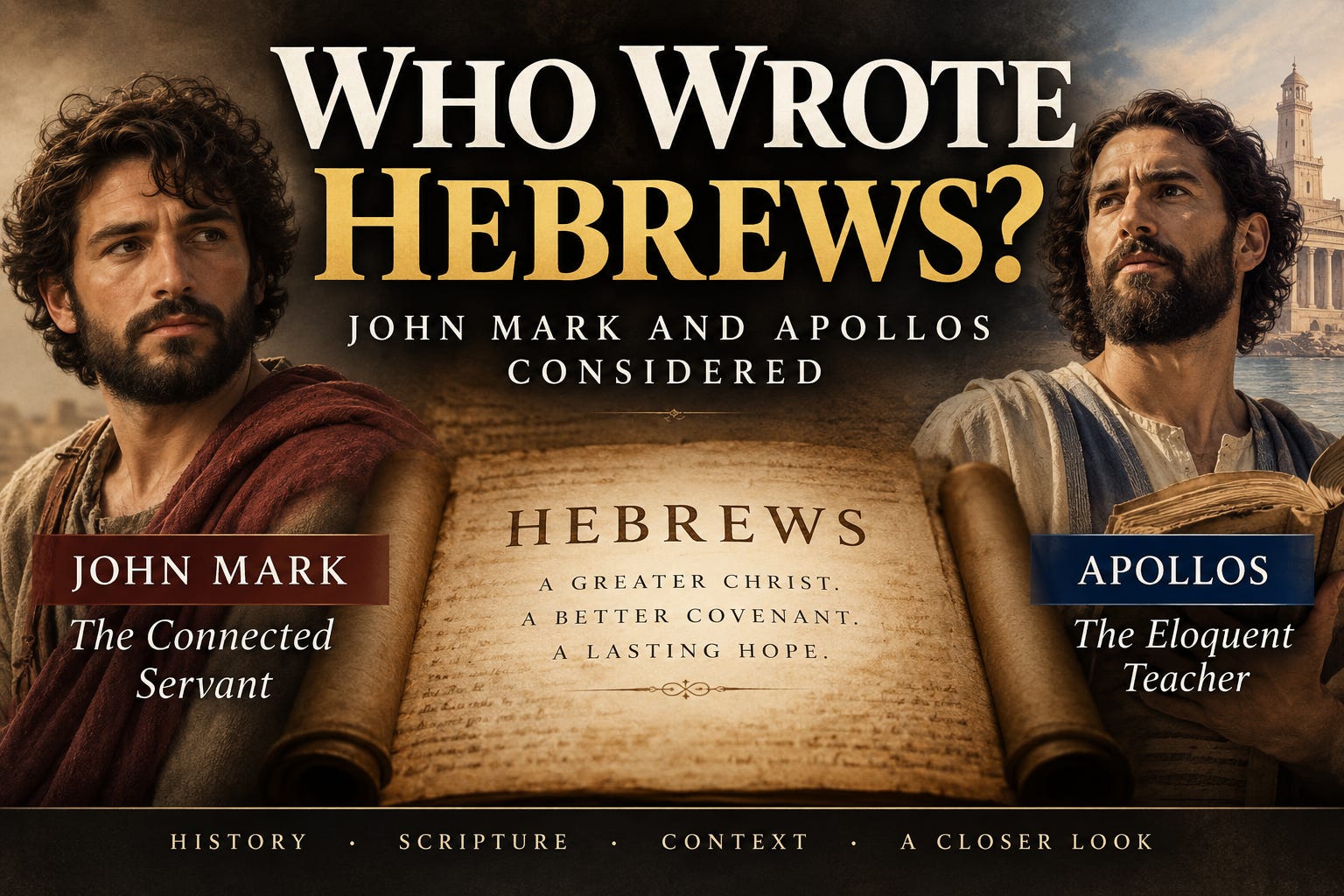
The Epistle to the Hebrews presents us with one of the more intriguing questions of New Testament authorship. The book itself does not identify its writer. Unlike Paul’s epistles, there is no opening salutation naming an apostle, nor does the writer identify himself anywhere in the body of the epistle.
For centuries, Paul was commonly regarded as the author, and the familiar title in the King James Bible is The Epistle of Paul the Apostle to the Hebrews. Yet the internal character of the book has caused many to question whether Paul actually penned it. Its vocabulary, style, structure, and manner of argument differ noticeably from Paul’s identified epistles.
That does not mean Hebrews is unrelated to Paul or his ministry. In fact, the closing chapter provides an important clue:“Know ye that our brother Timothy is set at liberty; with whom, if he come shortly, I will see you.”
— Hebrews 13:23
Whoever wrote Hebrews knew Timothy personally and expected possibly to travel with him. The writer therefore appears to have had some connection with the circle in which Paul and Timothy ministered.Among the many names proposed through the centuries, two are particularly interesting: John Mark and Apollos. Neither can be proven to have written Hebrews, but both possess characteristics that make the possibility worth considering.
The Case for John Mark
John Mark occupies an unusual position in the book of Acts and the apostolic epistles. He had meaningful associations with both Peter and Paul.When Peter was miraculously released from prison, he went:“to the house of Mary the mother of John, whose surname was Mark.”
— Acts 12:12Mark later accompanied Barnabas and Saul:“And Barnabas and Saul returned from Jerusalem, when they had fulfilled their ministry, and took with them John, whose surname was Mark.”
— Acts 12:25He accompanied them into their ministry but departed from them at Perga (Acts 13:13). That departure eventually contributed to the disagreement between Paul and Barnabas recorded in Acts 15:36–40. Barnabas took Mark, while Paul chose Silas.Whatever difficulties existed at that time were not permanent. Years later Paul referred favorably to Mark, calling him a fellowlabourer in Philemon 24. Near the end of Paul’s life he instructed Timothy:“Take Mark, and bring him with thee: for he is profitable to me for the ministry.”
— 2 Timothy 4:11This gives us an interesting connection. Hebrews was written by someone who knew Timothy, and John Mark clearly knew both Paul and Timothy.But Mark’s connections extended in another direction as well.
Peter wrote:”The church that is at Babylon, elected together with you, saluteth you; and so doth Marcus my son.”
— 1 Peter 5:13
Whatever precise relationship Peter intended by “Marcus my son,” the statement demonstrates a close association between Peter and Mark.That makes Mark an intriguing candidate for Hebrews. He stood at an unusual intersection. He had close connections with Peter and the Jerusalem believers, yet he also ministered among Paul and his associates.Such a background could help explain a book that is thoroughly Hebrew in its subject matter while nevertheless having recognizable connections with the Pauline circle.
A Possible Levitical Connection
There is another interesting consideration.Mark was related to Barnabas. Paul identifies:“Marcus, sister’s son to Barnabas”
— Colossians 4:10Barnabas, meanwhile, is specifically identified as:”a Levite”
— Acts 4:36
We should be cautious here. Mark’s relationship to Barnabas does not establish that Mark himself was a Levite. The family relationship does, however, place him in close proximity to a Levitical family.That becomes interesting when we consider the content of Hebrews.Few books of the New Testament display such sustained familiarity with the priesthood, sacrifices, tabernacle, covenant, and Levitical system. Hebrews 7–10 in particular develops an extended argument concerning the Levitical priesthood and its relationship to the superior priesthood of Christ after the order of Melchisedec.A writer with close family connections to the Levitical world would certainly be compatible with that material.The same fact, of course, has long contributed to the suggestion that Barnabas himself may have written Hebrews.
The Difficulty With Mark
The principal weakness of the Mark theory is historical.There is no known early tradition identifying John Mark as the author of Hebrews. That does not make his authorship impossible, but it means the case must be constructed almost entirely from circumstantial evidence.Mark fits several pieces of the puzzle, but we possess no ancient testimony telling us that he actually wrote the book.
The Case for Apollos
If Mark is an intriguing possibility, Apollos may present an even stronger internal profile.Luke introduces him in Acts with an unusually detailed description:”And a certain Jew named Apollos, born at Alexandria, an eloquent man, and mighty in the scriptures, came to Ephesus.”
— Acts 18:24
Nearly every part of that description deserves attention when considering the authorship of Hebrews.He was a Jew.He was Alexandrian.He was eloquent.And he was mighty in the scriptures.
Those characteristics correspond remarkably well with what we encounter in Hebrews.
An Eloquent Man
Hebrews is an extraordinarily sophisticated composition. Even apart from questions of theology, its literary character distinguishes it from much of the New Testament.Its arguments are carefully constructed and sustained. The writer moves from proposition to Scripture, from Scripture to explanation, and from explanation to exhortation. Major themes introduced early in the book reappear and develop throughout it.The extended arguments concerning Melchisedec, the priesthood, the covenants, the tabernacle, and the sacrifices require considerable intellectual discipline.The description of Apollos as “an eloquent man” therefore deserves more than passing notice.If we were searching among named New Testament individuals for someone possessing the intellectual and rhetorical ability necessary to compose Hebrews, Apollos would immediately deserve consideration.
Mighty in the Scriptures
Even more significant may be Luke’s statement that Apollos was “mighty in the scriptures.”Hebrews does not merely quote Scripture. Its author reasons from Scripture.Psalm 2, Psalm 8, Psalm 95, Psalm 110, Jeremiah 31, and numerous passages from the law are woven into sustained theological arguments. The writer can take a relatively brief Old Testament reference to Melchisedec and develop its implications for the priesthood of Christ over several chapters.Hebrews 7–10 demonstrates especially well the writer’s mastery of Israel’s Scriptures and institutions.That sounds very much like a man who could properly be described as “mighty in the scriptures.”
Acts provides further evidence of Apollos’ ability:” For he mightily convinced the Jews, and that publickly, shewing by the scriptures that Jesus was Christ.”— Acts 18:28
That statement could almost serve as a description of the method employed throughout Hebrews.The author addresses Hebrew readers and demonstrates from their own Scriptures the identity, supremacy, priesthood, sacrifice, and sufficiency of Christ.
The Alexandrian Connection
Apollos was born at Alexandria.That is potentially significant because Hebrews demonstrates considerable familiarity with the Greek Old Testament. Alexandria was one of the great centers of Jewish learning in the Greek-speaking world, and an educated Alexandrian Jew would naturally be comfortable working with the Scriptures in Greek.We should not press this evidence beyond what it can bear. Being Alexandrian does not prove that Apollos wrote Hebrews. Nevertheless, when combined with Luke’s explicit description of him as both eloquent and mighty in the Scriptures, it strengthens the profile.We are not merely looking for an educated man. We are looking for an educated Jewish man with extraordinary command of Israel’s Scriptures and the rhetorical ability to construct a sophisticated argument from them.
Acts tells us that Apollos was precisely such a man.
Apollos and the Pauline Circle
There is another important consideration.When Apollos first appears in Acts, his understanding is incomplete:“This man was instructed in the way of the Lord; and being fervent in the spirit, he spake and taught diligently the things of the Lord, knowing only the baptism of John.”— Acts 18:25
Aquila and Priscilla then:“took him unto them, and expounded unto him the way of God more perfectly.”— Acts 18:26
This is particularly interesting because Aquila and Priscilla had ministered closely with Paul.Afterward Apollos became an important minister among the believers at Corinth. Paul could write:”I have planted, Apollos watered; but God gave the increase.”— 1 Corinthians 3:6
Paul clearly regarded Apollos as a fellowlaborer.Yet Apollos was not merely functioning as Paul’s subordinate. In 1 Corinthians 16:12 Paul provides an interesting glimpse of their relationship:
“As touching our brother Apollos, I greatly desired him to come unto you with the brethren: but his will was not at all to come at this time; but he will come when he shall have convenient time.”
Paul wanted Apollos to go to Corinth, but Apollos determined that it was not the appropriate time.This suggests an independent minister who nevertheless enjoyed Paul’s confidence and fellowship.Such a man would make sense as the author of a book that has connections with the Pauline sphere but does not read like one of Paul’s epistles.It would also make the reference to Timothy in Hebrews 13:23 entirely natural. Apollos moved within the same broad ministry network in which Timothy was well known.
Mark and Apollos Compared
Both candidates can account for important features of Hebrews, but they do so in somewhat different ways.
John Mark offers a fascinating biographical bridge. He had intimate connections with Peter and the Jerusalem believers while eventually becoming a trusted associate of Paul. His relationship with Barnabas provides at least a possible connection with a Levitical family. He also belongs naturally to the circle in which Timothy was known.
Apollos, however, offers an unusually strong intellectual and Scriptural profile. Acts explicitly identifies him as a Jew, an Alexandrian, an eloquent man, and mighty in the Scriptures. It further describes his particular ability to convince Jews publicly by demonstrating from Scripture that Jesus was Christ.
Mark fits the apostolic relationships surrounding Hebrews remarkably well.
Apollos fits the actual composition of Hebrews remarkably well.
That distinction may be the most useful way of comparing them.
An Interesting Dispensational Consideration
For those who recognize the distinctive apostleship and revelation committed to Paul, the question takes on another dimension.Hebrews does not need to be Pauline in authorship in order to contain truths compatible with things Paul taught. Nor does its association with someone from Paul’s ministry circle require that Hebrews be addressed to the Body of Christ.Both Mark and Apollos occupied positions that could explain such connections.
Mark had known Peter and Paul.
Apollos had been instructed more perfectly by Aquila and Priscilla and subsequently labored alongside Paul.
Either man therefore could have possessed knowledge gained through association with Paul while writing specifically to Hebrews from the standpoint of Israel’s Scriptures and promises.
Apollos may be particularly interesting in this regard. Before meeting Aquila and Priscilla he was already an accomplished Jewish teacher who knew the Scriptures and preached Christ. After they “expounded unto him the way of God more perfectly,” he continued a powerful ministry of demonstrating from the Scriptures that Jesus was Christ.
If Hebrews came from such a man, its character would hardly be surprising.
What Can We Know?
Ultimately, Scripture does not tell us who wrote Hebrews.That fact should restrain our conclusions.
John Mark is possible. His relationships with Peter, Paul, Barnabas, and Timothy make him a more interesting candidate than is sometimes recognized.
Apollos is also possible. Unlike Mark, however, the explicit biblical description of Apollos corresponds strikingly with the abilities displayed by the author of Hebrews:
“an eloquent man, and mighty in the scriptures.”
There is no early historical tradition identifying Apollos as the author. The suggestion appears relatively late in church history and is especially associated with Martin Luther. Consequently, Apollos cannot be declared the author on historical grounds.
Nevertheless, if the question is not, Can we prove who wrote Hebrews? but rather, Which named New Testament individual best fits the internal profile of its writer?—Apollos deserves serious consideration.
Perhaps that is where the matter should remain.
We know considerably more about what the writer believed than about who the writer was. The Holy Spirit has preserved the former for us while leaving the latter unnamed.
John Mark provides an intriguing possibility.
Apollos provides a compelling one.
But where Scripture remains silent, certainty should remain silent as well.
What a great article, thank you Hal. I've never considered ol Apollos as the writer but you raise a good argument.
Excellent